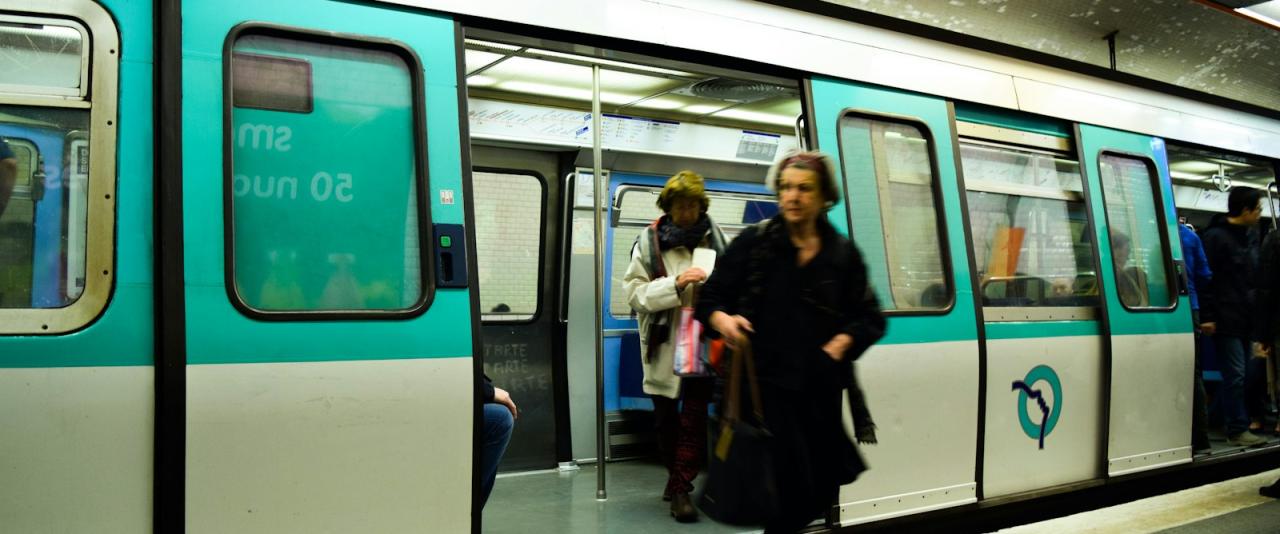
How the Network Fits Together
Paris public transport is run under the umbrella of Île-de-France Mobilités, the regional transport authority. Inside the city the main tool is the metro: 16 lines, numbered 1 to 14 plus the short 3bis and 7bis. Stations are close together, so the metro is best for trips within Paris itself.
The RER is a set of five express lines, A to E, that cross the city on a few deep stations and then fan out into the suburbs. Inside Paris it is useful for longer hops, for example between Châtelet-Les Halles and Gare du Nord or La Défense. Outside the city it is how you reach Versailles (RER C), Disneyland Paris (RER A) and Charles de Gaulle airport (RER B). Transilien suburban trains and the tram lines complete the picture.
Tickets and Prices in 2026
The fare system was simplified in January 2025 and the old zone-based single tickets disappeared. There are now a few flat-fare tickets:
- Metro-Train-RER ticket: €2.55 for a single journey anywhere in the region by metro, RER or train, except to and from the airport stations.
- Bus-Tram ticket: €2.05 for a journey by bus or tram.
- Paris-Airports ticket: €14 for a journey to or from Charles de Gaulle or Orly by rail.
Paper tickets are no longer sold. The options for visitors are the Navigo Easy card, a contactless card sold for €2 at station counters and machines that you load with tickets or day passes, or the Île-de-France Mobilités app, which puts tickets on a compatible smartphone.
For a stay of a week, the Navigo Semaine weekly pass (€32.40 in 2026, all zones, airports included) can be cheaper if you ride a lot. It is valid from Monday to Sunday, not for seven days from purchase, and goes on sale the Friday before. It cannot be loaded onto a Navigo Easy card: you need a Navigo Découverte card (€5, sold at ticket counters, with a passport-style photo) or a named Navigo account on your phone. At €2.55 a ride it beats single tickets after about 13 journeys, and rates change each January.
Getting to and from the Airports
From Charles de Gaulle, RER B runs from Terminals 1 and 2 straight through Gare du Nord, Châtelet-Les Halles and Saint-Michel Notre-Dame. Some trains stop everywhere, others skip suburban stations, so the journey time varies. The station is in the airport, signed from arrivals.
Orly has been on metro line 14 since mid-2024. The automated line runs to central stations including Gare de Lyon, Châtelet and Saint-Lazare. You need the Paris-Airports ticket for this journey, not the standard metro ticket.
Hours and Night Travel
The metro runs from about 5:30 in the morning until roughly 1:15 at night, with service extended to around 2:15 on Friday and Saturday nights and before public holidays. Outside those hours the Noctilien night bus network takes over.
Using the System Day to Day
- Validate every journey. Tap your card or phone on the reader at the gate. Keep the ticket until you leave the network: you need it to exit some RER stations, and inspectors fine travellers without a valid ticket.
- Read the direction by the terminus. Each line is signed by its end station, so to go east on line 1 you follow "Château de Vincennes".
- Doors. On older trains the doors do not open automatically; press the button or lift the handle.
- Escalators. Stand on the right, walk on the left.
- Busy hubs. Châtelet-Les Halles and Gare du Nord are large and confusing. Allow extra time for changes, and consider walking between nearby stations instead of making a long underground transfer.
Accessibility and Luggage
Most metro stations date from the early 20th century and have stairs rather than lifts, which makes them difficult with a wheelchair, a buggy or large suitcases. Line 14 is fully step-free and many RER stations have lifts. Buses are low-floor and are often easier for travellers with reduced mobility. If you arrive with heavy luggage, a direct RER or line 14 ride followed by a short taxi trip can save a lot of stair climbing.
Staying Safe
Pickpocketing is common on crowded lines, especially line 1, line 4, RER B and around tourist stations. Keep phones out of back pockets, wear bags in front in crowds and be cautious near the doors, where thieves can step off as the doors close. Official staff wear RATP or SNCF uniforms and badges; do not buy tickets from people offering help at machines.