







- Where
- Paris, Île-de-France
- Directions
- Directions
The Arc de Triomphe du Carrousel is the smaller and older of the two triumphal arches of Paris, and it stands in the Place du Carrousel, between the wings of the Louvre and the entrance to the Tuileries Garden. It was built between 1806 and 1808 on the orders of Napoleon, to the design of the architects Charles Percier and Pierre-François-Léonard Fontaine, to celebrate the victories of the Grande Armée in the campaign of 1805, in particular the surrender of Ulm and the battle of Austerlitz. It served as the monumental entrance to the Tuileries Palace, the residence of the emperor, which stood behind it until it was burned by the Commune in 1871 and its ruins were demolished.
The arch is about nineteen metres high and follows the model of the Arch of Septimius Severus in Rome. It has a large central opening flanked by two smaller ones, and it is built of stone faced with pink marble, with eight columns of marble, which support a rich entablature. On top of each column stands a statue of a soldier of the Grande Armée in the uniform of a different regiment, among them a cuirassier, a dragoon, a grenadier and a sapper, which gives the monument a lively look. Marble reliefs between the columns depict scenes from the campaign, including the capitulation of Ulm, the arrival in Munich and the meeting of the emperors after Austerlitz, and they record the glory of the army.
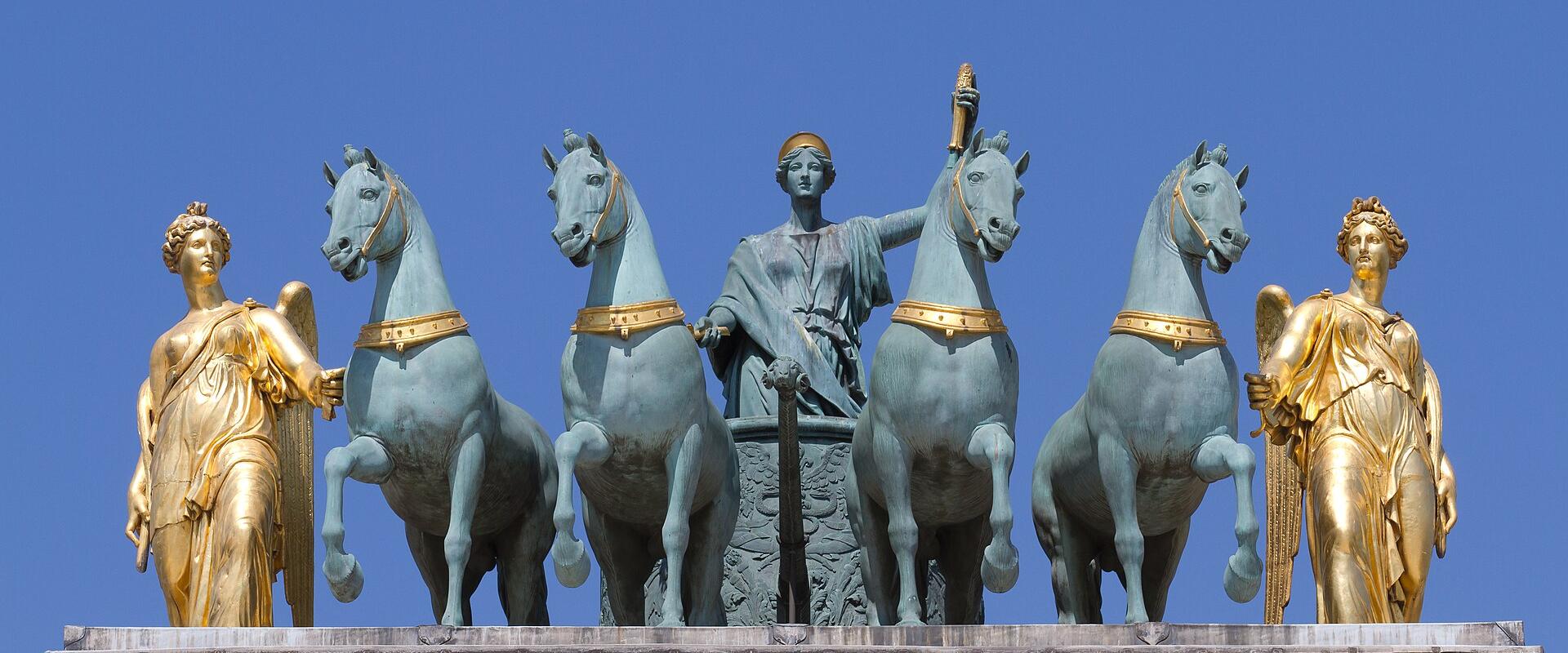
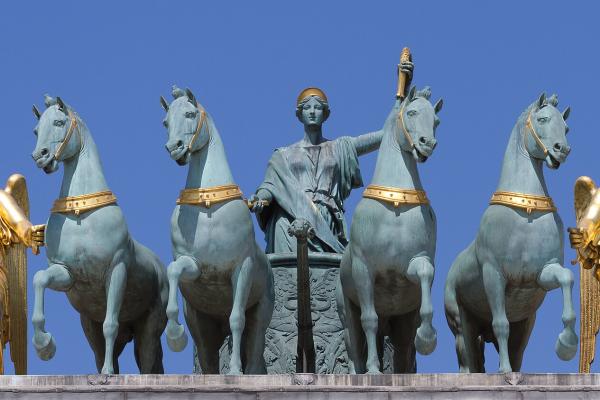
The summit has a history of its own. The emperor had a team of four bronze horses, the horses of Saint Mark, which had been taken from the basilica of Venice in 1798, placed on top of the arch with a chariot, as a trophy of victory. After the fall of Napoleon the horses were returned to Venice in 1815, and the arch was given a new group, a quadriga designed by the sculptor Baron Bosio, a chariot drawn by four horses carrying an allegorical figure of the Restoration, which remains today.
The arch is the start of a great line of monuments, called the historic axis of Paris, which runs west from the Louvre through the Tuileries Garden, the Place de la Concorde and the Champs-Élysées to the larger Arc de Triomphe on the Place de l'Étoile and on to the towers of La Défense, so that when you stand under the arch and look along the garden, you see this grand perspective. The glass pyramid of the Louvre, designed by I. M. Pei and opened in 1989, stands in the courtyard to the other side, in a striking contrast.
The monument is in a public square, so it is free to see at any time of day and the best light is in the afternoon. The surrounding Jardin du Carrousel, with its sculptures by Aristide Maillol, is a pleasant place to rest. The arch is close to the Jardin du Palais Royal and the Musée du Louvre, and it suits anyone interested in Napoleonic history and the layout of the city.
Categories
More photos coming soon
Nearby Attractions
Other places to visit in Paris
Eiffel Tower
324m iron lattice tower built for 1889 World's Fair
From €3.80 Historic Architecture · Towers
Montmartre and Sacré-Cœur
White basilica atop Montmartre hill
Free Guided Experiences · Historic Architecture
Cluny Museum (Musée de Cluny)
Medieval abbey and museum in Burgundy
From €8 Historic Architecture · Museums & Culture
The Louvre Museum
World's largest art museum in historic Paris palace
From €22 Guided Experiences · Historic Architecture
Questions people ask
Quick Facts
Best Time to Visit
April to June and September to October offer mild weather and fewer crowds for optimal exploration.