







- Where
- Paris, Île-de-France
- Directions
- Directions
The Place de la Bastille is a large and busy square in the east of Paris, where the fourth, eleventh and twelfth arrondissements meet, and it is one of the key places of French history. Nothing is left of the fortress that gave it its name, but the story of the building that stood here for four centuries, and of the day in 1789 when it fell, is at the root of modern France.
The Bastille was a medieval fortress, begun in the fourteenth century under Charles V as part of the defences of the east side of Paris, with eight massive towers. Over the centuries it lost its military role and became a state prison, where people were held by order of the king, sometimes without trial, among them writers, political prisoners and nobles. By 1789 it housed only a handful of prisoners, but it had become a symbol of royal tyranny. On 14 July 1789, a crowd of Parisians, looking for gunpowder and weapons and angered by the dismissal of a reforming minister, attacked the fortress, and after several hours of fighting its governor surrendered. The event marked the beginning of the French Revolution, and 14 July is now the French national day. The fortress was demolished within a few months by a contractor, Palloy, who sold pieces of the stone as souvenirs, and on 14 July 1790 the first popular ball was held on the ruins, a tradition that still goes on every year with dancing in the streets.
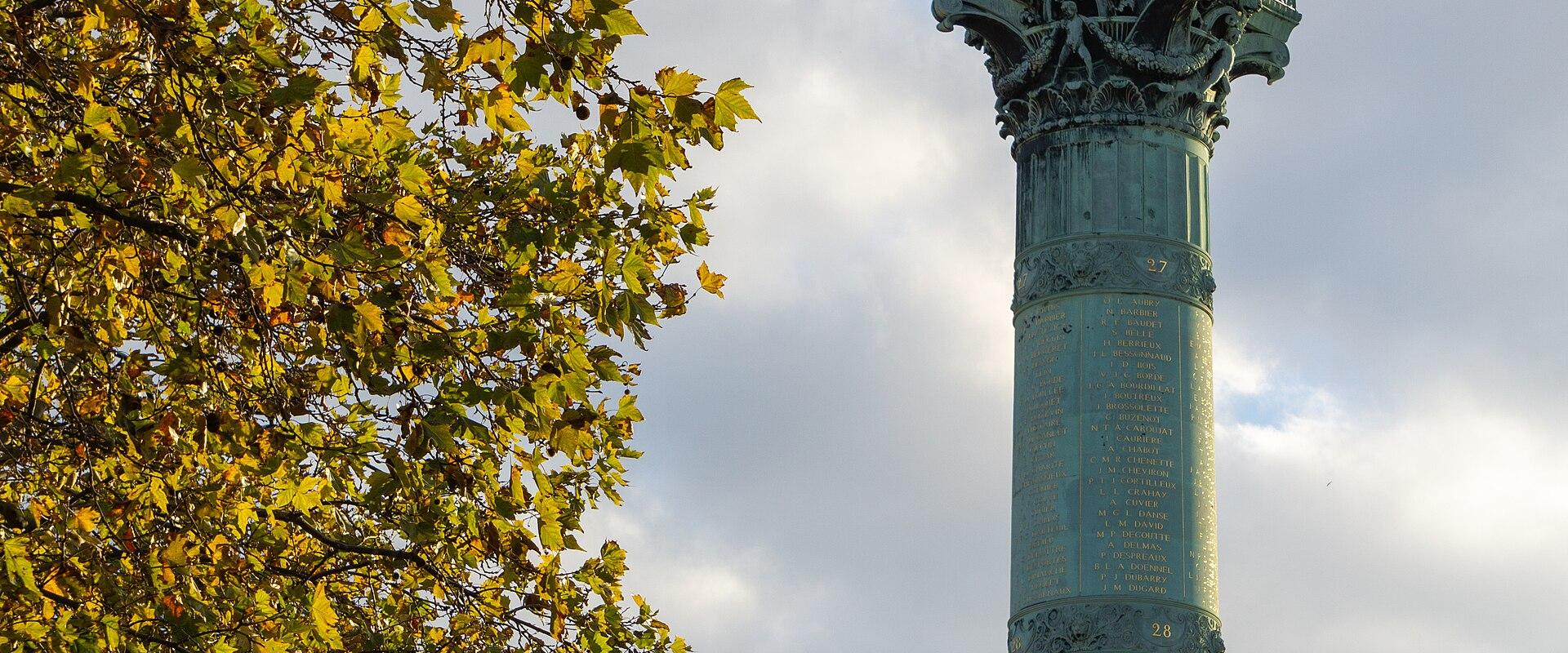
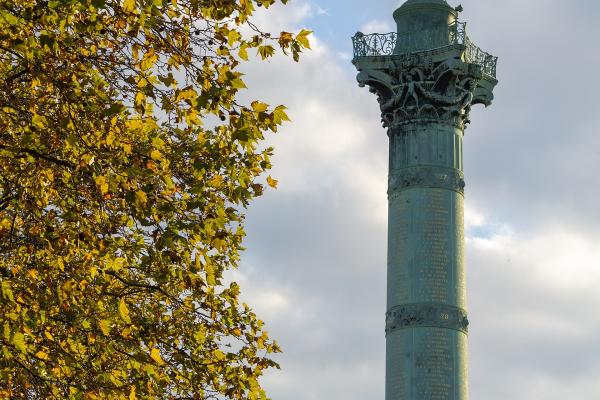
The centrepiece of the square is the July Column, a tall bronze column topped by the golden figure of the Spirit of Liberty, built in 1840 to commemorate the Revolution of July 1830, which overthrew Charles X, and not the storming of the Bastille, as many visitors assume. The remains of the fighters of 1830 and later 1848 lie in vaults beneath it. The outline of the fortress is marked on the paving of the square, and a few stones from its foundations were moved to a nearby garden.
The square itself has changed over time. In the nineteenth century, Haussmann's rebuilding of Paris reshaped the surroundings, and in 1984, an old railway station was demolished and replaced by the Opéra Bastille, which opened in 1989 for the bicentenary of the Revolution. To the south, a marina, the Port de l'Arsenal, links the Canal Saint-Martin to the Seine, and the Promenade Plantée, a raised garden walk, starts nearby. The streets nearby, such as the Rue de Lappe, have long been known for bars and nightlife.
The square is public and open at any time, and it suits history lovers and anyone exploring eastern Paris. Allow half an hour.
Categories
More photos coming soon
Nearby Attractions
Other places to visit in Paris
Eiffel Tower
324m iron lattice tower built for 1889 World's Fair
From €3.80 Historic Architecture · Towers
Montmartre and Sacré-Cœur
White basilica atop Montmartre hill
Free Guided Experiences · Historic Architecture
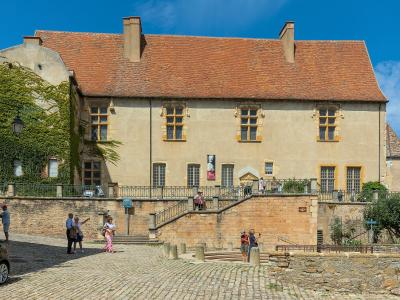
Cluny Museum (Musée de Cluny)
Medieval abbey and museum in Burgundy
From €8 Historic Architecture · Museums & Culture
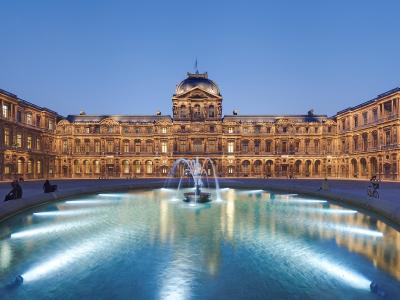
The Louvre Museum
World's largest art museum in historic Paris palace
From €22 Guided Experiences · Historic Architecture
Questions people ask
Quick Facts
Best Time to Visit
April to June and September to October offer mild weather and fewer crowds for optimal exploration.