Yes, Nice is generally safe for tourists, including at night in the central areas and for women travelling alone; the realistic risk for a visitor is theft, not violence. Pickpocketing on the Promenade des Anglais and in Vieux Nice, bag and phone snatching, thefts on the busy tram from the airport and break-ins to parked cars cause most of the problems, and a few habits prevent nearly all of them. In an emergency, dial 112 (all emergencies), 17 (police) or 15 (medical).
This guide sets out what actually goes wrong, where to take more care after dark, how safe the beaches are, and what to do if something is stolen. It does not quote crime statistics, because no official figures exist that break down risk for visitors to Nice; what it does quote comes from the UK Foreign Office's France travel advice and the French government's own service pages.
Quick facts (checked October 2026)
- Emergency numbers: 112 (European number, any phone), 17 (police), 15 (Samu, medical), 18 (fire brigade), 196 (sea rescue from the coast), 114 (by text, for people who cannot speak on the phone).
- Main risk: theft from bags, pockets, tables and cars, mostly in crowded places.
- Reporting a theft: in person at a police station, or online through the French Interior Ministry's plainte en ligne service, which is open to foreign visitors.
- Beaches: pebble, shelving quickly into deep water; 11 beaches have lifeguards in July and August.
Is Nice safe for tourists?
For most visitors, yes. Nice is a large city, the fifth-biggest in France, and it has the ordinary crime of a large city, concentrated where people are distracted: the seafront, the old town, the main shopping street, Avenue Jean-Médecin, the station and public transport. The UK government's travel advice for France asks travellers to "take sensible precautions against street crime and car crime" and describes the classic pickpocket method that applies here as much as in Paris: thieves often work in pairs or groups, one distracting you while another goes into your bag.
What that means in practice:
- Carry your bag across your body and closed, with the opening towards you.
- Keep your phone in your hand or a front pocket, not on a café table or the back of a deckchair.
- Split cards and cash, and leave passports in the hotel safe unless you need them. You do have to be able to prove your identity if police ask, so carry a copy or a photo of it.
- Be wary of anyone who approaches you with a petition, a dropped ring, a question with a map held over your phone, or a sudden "you have something on your jacket".
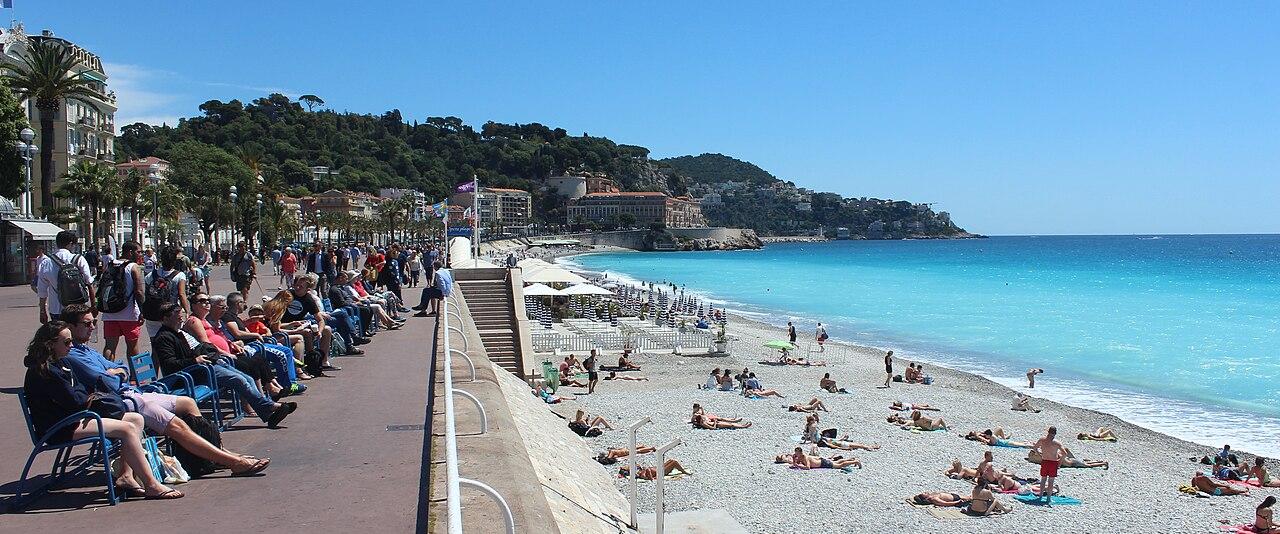
 The Promenade des Anglais on a spring afternoon, with the pebble beach below and Castle Hill in the distance. Image: Uhooep, CC BY-SA 4.0, via Wikimedia Commons.
The Promenade des Anglais
The seafront promenade runs about seven kilometres around the Baie des Anges, and on a sunny day it is full of walkers, runners, cyclists and people on the blue chairs. The usual thefts here are opportunistic: a phone left on a chair or a towel, a bag hung on the back of a seat at a beach restaurant, a wallet taken in a crowd watching a street performer. Cyclists and scooter riders sometimes snatch phones held loosely at the kerb.
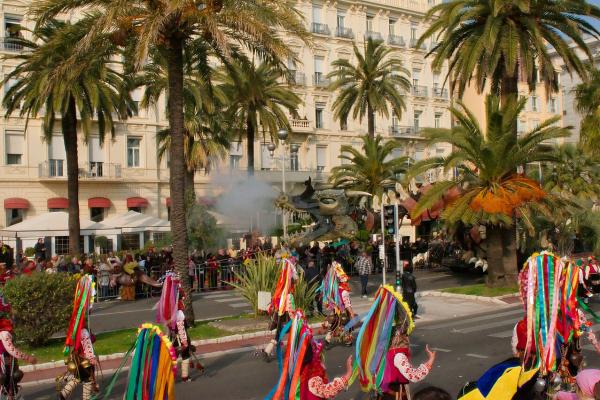
The Promenade is also where Nice suffered its worst modern tragedy: on 14 July 2016 a truck was driven into the crowd watching the Bastille Day fireworks, killing 86 people. The UK advice states that terrorists are very likely to try to carry out attacks in France and lists crowded places, events and transport hubs among likely targets. That is a country-wide warning rather than one about Nice, and large events such as the Nice Carnival now take place inside fenced enclosures with access controls. Follow any instructions from security staff and keep an eye on local news during your stay.
 The Promenade des Anglais at night, lit along the whole curve of the Baie des Anges. Image: Miguel Mendez, CC BY 2.0, via Wikimedia Commons.
Is Nice safe at night?
In the centre, yes, with the usual care. The Promenade, Place Masséna, Avenue Jean-Médecin and the streets of Vieux Nice stay busy until late, especially from spring to autumn, and you will be walking among plenty of other people. The places to be more alert after dark are:
- Vieux Nice late at night. The old town's bars around Cours Saleya and Place Rossetti are lively and generally good-natured, but the narrow side streets empty quickly after midnight, and drunk crowds are where pickpockets and occasional fights happen. Walk out on the main streets rather than through the darkest alleys.
- The area around Nice-Ville station. As in most French cities, the streets around the main station are less pleasant late at night. If you arrive on a late train, walk on the main avenues or take a taxi from the rank.
- The beach after dark. The pebble beach below the Promenade is unlit in most places. It is fine for a quiet sit at dusk, but do not leave belongings unattended or wander far along the shore alone late at night.
The neighbourhoods that appear in the French news for drug-related crime, such as Les Moulins in the west and L'Ariane in the north-east, are residential districts well away from anywhere a visitor would normally go.
 Cours Saleya at night, where the old town's restaurant terraces stay busy until late. Image: Irina Korch, CC BY-SA 4.0, via Wikimedia Commons.
Is Nice safe for solo female travellers?
Nice is a common choice for women travelling alone, and the advice is the same as for any large French city. The UK guidance warns about "date rape" drugs including GHB in bars and clubs: buy your own drinks, watch them being poured and keep them in sight. It also notes that drinks in French bars are often stronger than travellers expect.
A few habits help on a night out: stay on busy, lit streets; agree a meeting point with anyone you are with; keep enough battery on your phone to call 112 or a taxi; and do not accept a lift from someone you have just met. Street harassment, unwanted comments or being followed for a few steps, does happen, as it does elsewhere in France; walking into a busy café or shop is the simplest way to shake someone off. France's national helpline for women facing violence is 3919 (support and advice, not an emergency line).
Our solo female traveller's guide to safe nightlife in Bordeaux covers the same ground in more detail for another French city, and most of it applies in Nice too.
 Café terraces on Place Rossetti, in front of the Cathedral of Sainte-Réparate in Vieux Nice. Image: Fred Romero from Paris, France, CC BY 2.0, via Wikimedia Commons.
Tram Line 2 and public transport
Tram Line 2 runs from both airport terminals to the city centre and on to the port, Port Lympia. The airport says it reaches the Jean-Médecin stop in under 30 minutes, with a tram every 7 to 8 minutes on weekdays, and it sells an AERO return ticket for €10. Tickets are sold from machines at the airport tram stops (coins or cards) and through the Lignes d'Azur ticket app; buy and validate before you board.
The tram is safe, but it is also where newly arrived visitors are easiest to rob: suitcases, phones out for directions, wallets just used at the ticket machine. On a crowded tram, keep your bag in front of you, your phone away when the doors open, and a hand on your luggage rather than leaving it in the rack out of sight. The same applies on Line 1 along Avenue Jean-Médecin and on the coastal trains to Monaco and Menton in summer and during the carnival, when they are packed.
France's national number for reporting a safety problem on public transport is 3117 (or text 31177).
 A Line 2 tram at the airport's Terminal 1 stop. Image: Snoopy 31, CC BY-SA 4.0, via Wikimedia Commons.
Car break-ins and parking
If you rent a car for the Riviera, assume that anything visible inside it may be taken. The UK advice is plain: do not leave valuables in your vehicle and keep the doors locked in slow-moving traffic. Use a staffed or barrier car park in town where you can, take everything with you at beach and viewpoint car parks, and do not leave luggage in the boot of a parked car on travel days if it can be avoided. Thieves watch the car parks of popular spots.
Is it safe to swim at Nice's beaches?
Nice's beaches are pebble, and they shelve steeply: a few steps in and you are out of your depth. That surprises swimmers used to sand, and getting out again over moving pebbles can be awkward, especially when there are waves. The city installs access ropes on ten beaches until the end of September to help people climb out.
The City of Nice lists 11 beaches with lifeguards in 2026, staffed from 9:00 to 18:30 between 1 July and 31 August. Six of them (Sainte-Hélène, Bambou, Magnan, Poincaré, Blue Beach and Beau Rivage) are guarded until 31 August, and five (Ponchettes, Tour Rouge, Forum, Carras and Centenaire) until 13 September. Outside those dates and hours, nobody is watching. The UK advice adds that local sea conditions can be dangerous even for strong swimmers, so learn the flag system and swim at a guarded beach in season. From the coast, sea rescue is 196.
All Nice beaches have been smoke-free since 2024, and dogs are allowed on only two of them, La Lanterne and Lenval.
 The pebble beach below the Promenade: it shelves quickly into deep water. Image: Uhooep, CC BY-SA 4.0, via Wikimedia Commons.
What to do if you are robbed in Nice
- If you are in danger or the thief is still nearby, call 17 or 112.
- Block your cards and phone straight away through your bank's and mobile operator's apps.
- Report the theft. You can go to a police station (commissariat), or use the online complaint service, plainte en ligne, on the Interior Ministry's masecurite.interieur.gouv.fr site. It covers property offences such as theft, burglary and damage when the culprit is unknown, it is free, and the site states that foreign visitors who are victims of theft in France can use it. A police officer may contact you to complete the statement in person, and the formal report (procès-verbal) is sent to your online account by email. Older guides mention a "pré-plainte en ligne"; the current service is the plainte en ligne. You need a report for an insurance claim.
- Lost passport: contact your country's embassy or consulate for an emergency travel document. The police report helps.
If the theft involved violence or you know who took your things, report it in person rather than online.
 Nice-Ville, the main railway station: keep a hand on your bags in the station and on the streets around it late at night. Image: CAPTAIN RAJU, CC BY-SA 4.0, via Wikimedia Commons.
Other everyday safety notes
- Scooters and bikes. Electric scooters and cyclists share the Promenade with pedestrians; look both ways before stepping off the cycle path.
- Heat. July and August can be very hot; carry water, and France runs a heatwave information line, 0800 06 66 66.
- Wildfires. In summer, the hills behind the Riviera can catch fire. Follow any closures of forest areas and call 112 or 18 if you see smoke.
- Port and Castle Hill. The harbour and Colline du Château are pleasant and busy by day; the park on the hill closes in the evening, so go up for the view in daylight.
The short version
Nice is a safe city to visit if you treat your phone, bag and car the way you would in any big European city. Most visitors' problems come from a moment of distraction in a crowd, not from danger. Keep valuables close on the Promenade, the tram and the old town, take the main streets home late at night, swim at guarded beaches in season, and save 112 and 17 in your phone.