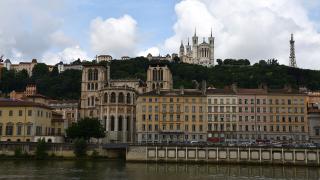


Lyon is France's food capital, a city of two rivers and Renaissance courtyards. It is also where the cinema was born, where a silk weaver's loom first ran on punched cards, where the world's first veterinary school opened, and where, in the darkest years of the 20th century, people risked their lives to hide and rescue others.
This is Lyon's bright side, in roughly the order it happened: the inventions and firsts it can claim, the people who made the city proud, and the traditions it still keeps. Every chapter ends with something you can go and see.
1184: A Hospital by the River
The Hôtel-Dieu, on the bank of the Rhône, began as a house for pilgrims and the sick, first recorded in 1184. For more than eight centuries it cared for the people of Lyon. In 1532 one of its physicians was the writer François Rabelais, who was paid 40 livres a year and published his first Pantagruel the same year. In the 18th century the architect Jacques-Germain Soufflot gave it the long riverside façade and great dome you see today.
The hospital closed in 2010. Instead of selling it off in pieces, the city turned it into the Grand Hôtel-Dieu, reopened in 2018 with its courtyards and passages open to the public.
 The Hôtel-Dieu on the Rhône, with Soufflot's dome. Image: Benoît Prieur, CC0, via Wikimedia Commons.
Where to see it today: the Grand Hôtel-Dieu, on the Presqu'île between Place Bellecour and the Guillotière bridge. Walk through its courtyards and gardens; the Cité Internationale de la Gastronomie occupies part of the old wards.
1761: The World's First Veterinary School
In 1761 a royal decree allowed the horseman and scholar Claude Bourgelat to open a school in Lyon to train doctors for animals. Cattle plague was devastating French farms, and nobody was trained to fight it. Teaching began in 1762 in an old inn in the Guillotière district. It is generally recognised as the first organised veterinary school in the world, and four years later Bourgelat founded a second one at Alfort, near Paris. Schools across Europe followed the model.
The school moved in 1796 to the Clos des Deux-Amants at Vaise, on the Saône, where it stayed until 1977. It now trains vets at Marcy-l'Étoile, west of the city.
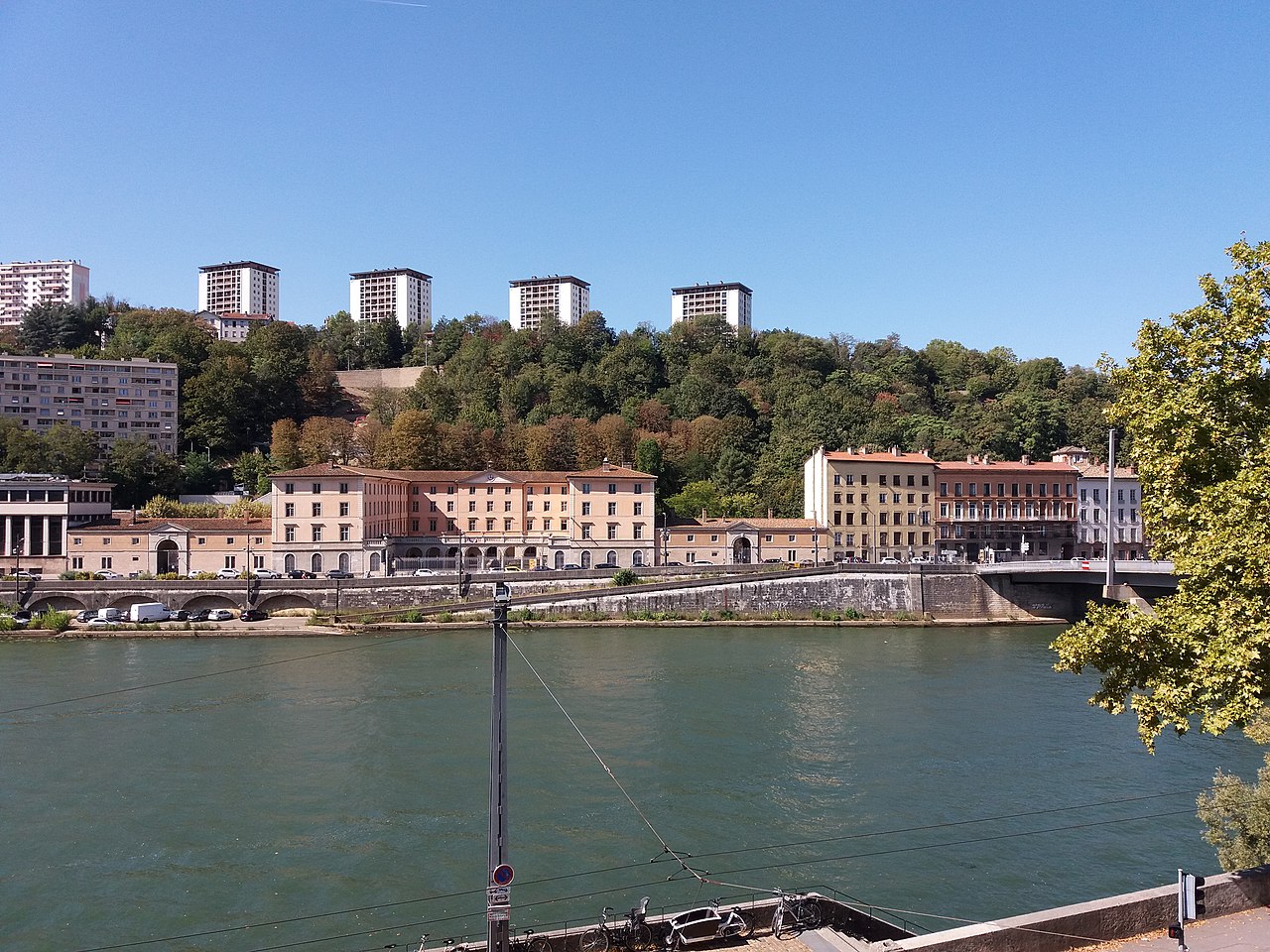 The former veterinary school at Vaise, on the Saône, now the Conservatoire. Image: Romainbehar, CC0, via Wikimedia Commons.
Where to see it today: the old Vaise buildings on the quai Chauveau, now the city's national Conservatoire of music and dance. Look across from the Saône quays.
1801–1804: The Loom That Could Read
Lyon lived on silk. By the 18th century thousands of weavers, the canuts, worked hand looms in the city. Weaving a patterned silk took two people: the weaver, and an assistant who pulled the threads for each row by hand.
Between 1801 and 1804 Joseph Marie Jacquard, a Lyon-born weaver's son, built a mechanism that did the assistant's job automatically. A chain of punched cards told the loom which threads to lift for each row: hole or no hole. He did not invent punched cards, which earlier Lyon inventors had tried, but he made them work. The Jacquard loom spread around the world.
It also had an afterlife. The English mathematician Charles Babbage owned a portrait of Jacquard woven in silk on a Jacquard loom, from thousands of cards, and borrowed the punched card for his design of a mechanical computer, the Analytical Engine. Punched cards fed computers until the 1970s.
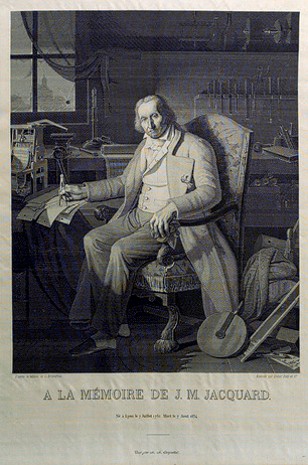 The famous portrait of Joseph Marie Jacquard, woven in silk on a Jacquard loom. Image: woven by Michel-Marie Carquillat (1803–1884) Claude Bonnefond (1796–1860), Public domain, via Wikimedia Commons.
 A working Jacquard hand loom at the Maison des Canuts. Image: Mdclyon4, CC BY-SA 4.0, via Wikimedia Commons.
Where to see it today: the Maison des Canuts, 10–12 rue d'Ivry on the Croix-Rousse hill, where guides demonstrate working looms; guided visits Tuesday to Saturday. A statue of Jacquard stands on the Place de la Croix-Rousse.
1831 and 1834: "Live Working or Die Fighting"
Silk made the merchants rich but left the weavers poor. In October 1831 the canuts won an agreed minimum price for their work, which many merchants then refused to pay. On 21 November the weavers came down from the Croix-Rousse under the slogan "Vivre en travaillant ou mourir en combattant", "live working or die fighting", and for a few days held the city. They rose again in April 1834.
Both revolts were put down, at the cost of hundreds of lives, and the minimum price was abolished. But they are remembered as one of the first great workers' movements of the industrial age, and their slogan travelled far beyond Lyon. The canuts also set up some of France's first mutual-aid societies and cooperative shops.
Where to see it today: the Croix-Rousse itself, with its tall weavers' buildings and high-ceilinged flats built to fit the looms. The Maison des Canuts tells the story of the revolts.
Lyon is laced with traboules, covered passages that cut through the buildings from one street to the next, across courtyards and up staircases. There are about 500, in Vieux Lyon, on the Croix-Rousse slopes and on the Presqu'île. They let the silk workers carry cloth down the hill under cover, and in the Second World War they helped the Resistance move unseen through the city.
Most are inside private buildings. In 1990 the city reached an agreement with the owners: the city helps pay for cleaning, lighting and restoration, and in return the public can walk through about 40 of them during the day.
The most famous is the Cour des Voraces on the Croix-Rousse, a courtyard with a monumental six-storey open staircase built around 1840. In 1995 a housing charity bought the run-down building and restored it.
 The open staircase of the Cour des Voraces on the Croix-Rousse. Image: Thomas ZILLIOX, CC0, via Wikimedia Commons.
 The pink tower in a courtyard off the rue du Bœuf, Vieux Lyon. Image: Fred Romero from Paris, France, CC BY 2.0, via Wikimedia Commons.
Where to see it today: look for the small plaques marking open traboules in Vieux Lyon (around rue Saint-Jean and rue du Bœuf) and on the Croix-Rousse. The Cour des Voraces opens from 9 place Colbert. Traboules are open from 7:00 to 19:00; people live here, so keep your voice down.
Around 1808: Guignol
Lyon's most famous citizen is a puppet. Guignol, a cheeky Lyon silk worker with a pigtail and a black hat, was created by Laurent Mourguet, a weaver's son who had become a tooth-puller and then a puppeteer. Tradition dates Guignol to 1808, though some historians think he appeared a few years later. With his friend Gnafron, Guignol mocked landlords, policemen and the powerful in the local dialect, and audiences loved him. He became the name for puppet theatre all over France.
 A Guignol glove puppet at the Musée des Arts de la Marionnette. Image: Romainbehar, CC0, via Wikimedia Commons.
Where to see it today: the Musée des Arts de la Marionnette in the Gadagne museums, Vieux Lyon, which holds the oldest known Guignol, made by Mourguet himself. Puppet shows still run at small theatres in Vieux Lyon.
1852: The Night the City Lit Its Windows
In 1643, with plague threatening Lyon, the city's councillors made a vow to honour the Virgin Mary if the city was spared. The ceremony is still held every 8 September at Fourvière.
Two centuries later, a gilded statue of the Virgin was to be set on top of the chapel on Fourvière hill. A flood delayed the ceremony to 8 December 1852. That evening the weather threatened to spoil it, then cleared, and people across Lyon put candles in their windows. Some had been asked to by Catholic notables; many did it on their own. The custom stuck.
Every year since, on the evening of 8 December, the people of Lyon put small candles called lumignons on their windowsills. Since 1999 the city has added the Fête des Lumières, four nights of light installations that draw well over a million visitors.
 Lumignons, candles in coloured glasses, on a Lyon windowsill on 8 December. Image: Myrabella, CC BY-SA 4.0, via Wikimedia Commons.
 The gilded Virgin on Fourvière, placed in 1852. Image: Joseph-Hugues Fabisch, Public domain, via Wikimedia Commons.
Where to see it today: the statue on the bell tower of the chapel at Fourvière, beside the basilica. Be in Lyon on the evening of 8 December, and look up at the windows.
1895: The Cinema
On 13 February 1895 the brothers Auguste and Louis Lumière patented the Cinématographe, a single machine that could film, print and project moving pictures. Their family ran a factory making photographic plates in the Monplaisir district of Lyon. One of the first films they made shows its workers walking out of the gates at the end of a shift: La Sortie de l'usine Lumière à Lyon. On 28 December 1895, in Paris, they held the first public screening for a paying audience.
They did not invent moving pictures alone: Thomas Edison's Kinetoscope came first, as a peep-show for one viewer at a time. What the Lumières made was cinema as we know it: a film projected on a screen for a room full of people.
The brothers kept inventing. In 1903 they patented the autochrome, the first industrial colour-photography process, sold from 1907. For about 30 years it was how the world took colour photographs.
 Auguste and Louis Lumière. Image: Unknown authorUnknown author, Public domain, via Wikimedia Commons.
 Three surviving versions of La Sortie de l'usine Lumière, filmed in Lyon. Image: Manuel Schmalstieg, Public domain, via Wikimedia Commons.
 An autochrome of the Saône at Lyon, from the collections of the Institut Lumière. Image: AnonymousUnknown author, CC0, via Wikimedia Commons.
Where to see it today:
- The Institut Lumière, 25 rue du Premier-Film, in the Lumière family's villa in Monplaisir (metro D, Monplaisir-Lumière). It is open Tuesday to Sunday.
- The Hangar du Premier-Film across the garden, the only surviving part of the factory, seen in the background of the 1895 film. It is now a cinema.
- The Festival Lumière, every October, Lyon's festival of classic cinema.
 The Hangar du Premier-Film, the last surviving part of the Lumière factory, now a cinema. Image: Benoît Prieur, CC0, via Wikimedia Commons.
1933: The Mothers of Lyon Cooking
Lyon's great cooking was built by women. The mères lyonnaises, the mothers of Lyon, were cooks, many of whom had worked in the kitchens of wealthy families before opening their own restaurants. They cooked simple, precise food from the produce of the region.
The greatest was Eugénie Brazier. In 1933 the Michelin guide gave three stars to her restaurant on rue Royale and three to her inn in the hills at Col de la Luère, making her the first person ever to hold six Michelin stars. One of the young cooks she trained was Paul Bocuse, whose restaurant outside Lyon held three stars from 1965 for 55 years, a record.
 Cheese at the Halles de Lyon–Paul Bocuse. Image: Benoît Prieur, CC0, via Wikimedia Commons.
Where to see it today:
- La Mère Brazier, 12 rue Royale, still a restaurant.
- The Halles de Lyon–Paul Bocuse, 102 cours Lafayette, the city's covered food market.
- Any bouchon, Lyon's traditional small restaurant.
1942: The Children of Vénissieux
During the Second World War, Lyon was in the unoccupied zone at first, then under German occupation from November 1942. It became a centre of the Resistance: on 14 September 1944, Charles de Gaulle called it the capital of the Resistance.
In August 1942 the Vichy police rounded up about a thousand foreign Jews from the Lyon region and held them at a camp in Vénissieux, on the city's edge, for deportation. On the night of 28 to 29 August, a group of rescuers from Jewish and Christian organisations, including the Catholic priest Alexandre Glasberg, the social worker Gilbert Lesage and members of the Jewish children's relief agency, used a loophole in the rules: unaccompanied children were exempt. They persuaded parents to sign their children over to them, and took 108 children out of the camp that night. They hid them in convents, families and homes across the region. All but three survived the war. Most of their parents were deported and murdered.
Both Glasberg and Lesage were later recognised by Yad Vashem as Righteous Among the Nations.
The Resistance leader Jean Moulin, sent by de Gaulle to unite the Resistance movements, was arrested by the Gestapo at a meeting in a doctor's house in Caluire, just north of Lyon, on 21 June 1943. He died after torture a few weeks later, without giving anything away.
 The plaque on the house in Caluire where Jean Moulin was arrested on 21 June 1943. Image: Romainbehar, CC0, via Wikimedia Commons.
Where to see it today:
- The Centre d'histoire de la Résistance et de la Déportation (CHRD), 14 avenue Berthelot, in the building the Gestapo used as its headquarters. It is open Wednesday to Sunday.
- The Mémorial Jean Moulin in the doctor's house at Caluire, open on certain days by booking.
 The entrance of the CHRD on avenue Berthelot. Image: Chrdlyon, CC BY-SA 4.0, via Wikimedia Commons.
1964: Saving Old Lyon
In the 1960s the city planned a fast road through Vieux Lyon, the Renaissance quarter between Fourvière and the Saône, which would have meant demolishing part of it. A residents' association, La Renaissance du Vieux Lyon, founded in 1946, fought it. On 12 May 1964, under a new law promoted by the culture minister André Malraux, Vieux Lyon became the first area in France to be designated a protected historic district.
The quarter was restored instead of being cut in two. In 1998 UNESCO listed the historic site of Lyon, from Fourvière to the Croix-Rousse slopes, as a World Heritage Site.
 A street in Vieux Lyon, protected since 1964. Image: Weekend Wayfarers, CC BY 2.0, via Wikimedia Commons.
Where to see it today: walk the length of the rue Saint-Jean and rue du Bœuf in Vieux Lyon, from the Cathédrale Saint-Jean north.
Lyon's Scientist: Ampère
André-Marie Ampère, born in Lyon in 1775, founded the science of electrodynamics, the study of how electric currents create magnetism. The unit of electric current, the ampere, is named after him.
 The statue of André-Marie Ampère on Place Ampère. Image: Romainbehar, CC0, via Wikimedia Commons.
Where to see it today: his statue on Place Ampère, between Bellecour and Perrache. Antoine de Saint-Exupéry, the author of The Little Prince, was born a few streets away in 1900; the airport and a street are named after him, and a statue of him with the Little Prince stands on Place Bellecour.
How to See Bright Lyon
A self-guided walk, about 5 km. Start on the Croix-Rousse at the Maison des Canuts, walk down through the Cour des Voraces and the slopes, cross the Saône to Vieux Lyon and its traboules, take the funicular up to Fourvière for the gilded Virgin and the view, come back down and cross to the Presqu'île past Place Bellecour and Place Ampère, and finish at the Grand Hôtel-Dieu on the Rhône.
Further afield:
- The Institut Lumière in Monplaisir (metro D).
- The CHRD on avenue Berthelot.
- The Halles de Lyon–Paul Bocuse.
- The Mémorial Jean Moulin at Caluire.
Dates to know:
- 8 September: the vow of 1643, at Fourvière.
- October: the Festival Lumière.
- 8 December: lumignons in the windows; the Fête des Lumières around it.
.jpg)


.jpg)


_d%C3%A9cembre_2023.JPG)


.jpg)
