
Paris sells itself as the city of light: cafés, boulevards, the Eiffel Tower sparkling on the hour. Under the postcard is a city that hanged its criminals by the dozen on a hill outside the walls, tore a man apart with horses in front of the town hall, and guillotined more than 2,000 people in two years. Its streets saw a religious massacre, the bloodiest week of street fighting in modern French history, and a police roundup of Jewish families by French officers. In 2025 thieves even took the crown jewels out of the Louvre in under eight minutes.
Paris has buried a lot of this, sometimes literally: six million of its dead lie in old quarries under the southern half of the city. But almost every chapter left something you can find, from a fountain to a plaque on a bridge. This guide goes through them in order and tells you where to look. Several of the sites commemorate people killed within living memory, so the last section has notes on visiting with care.
The Gibbet of Montfaucon
For most of the Middle Ages, travellers approaching Paris from the north-east passed the royal gallows. The Gibbet of Montfaucon stood on a hill outside the walls. A wooden gallows probably stood there from the 11th century, and it was rebuilt in stone in the early 1300s: sixteen stone pillars, about 16 metres high, joined by wooden beams from which around fifty bodies could hang at once. Bodies were left there to rot as a warning, and new ones were added as old ones fell. The last executions took place in the late 1620s, and the remaining pillars were pulled down around 1790.
 The Gibbet of Montfaucon, reconstructed by the architect Viollet-le-Duc: sixteen pillars, beams, and a pit for the bones below. Image: , Public domain, via Wikimedia Commons.
Where to see it today: nothing of the gibbet survives above ground. Its hill lies under the housing and small square around rue Boy-Zelenski in the 10th arrondissement, near Colonel Fabien metro. Two city history plaques mark the area: one on rue de Meaux and one at the corner of rue de la Grange-aux-Belles and rue des Écluses-Saint-Martin. In 1954, workmen digging a garage at 53 rue de la Grange-aux-Belles found pillar bases, paving and human bones.
Place de Grève: Executions in Front of the Town Hall
Inside the walls, the city's main place of execution was the Place de Grève, the riverside square in front of the Hôtel de Ville. Executions there were public events with huge crowds. The mystic Marguerite Porete was burned there for heresy in 1310. Ravaillac, who assassinated King Henri IV, was torn apart by horses there on 27 May 1610. In 1680 the poisoner La Voisin, at the centre of the scandal known as the Affair of the Poisons, was burned alive.
The most notorious execution was that of Robert-François Damiens, who had stabbed Louis XV with a penknife. On 28 March 1757 he was tortured and then quartered by horses in front of a huge crowd, with spectators renting windows overlooking the square.
 The execution of Damiens on Place de Grève, 28 March 1757. Image: Unknown authorUnknown author, Public domain, via Wikimedia Commons.
The square also saw the guillotine's first use: on 25 April 1792, a highwayman named Nicolas Pelletier became the first person to be executed with it. Executions on the Place de Grève ended in 1830, and in 1832 they were moved to the edge of the city.
Where to see it today: the square is now the Place de l'Hôtel-de-Ville, a wide open space in front of the town hall that hosts events and markets. Nothing marks where the scaffold stood.
St Bartholomew's Day, 1572
In August 1572, Paris was full of Protestant (Huguenot) nobles who had come for the wedding of the Protestant Henri of Navarre to the king's Catholic sister. On 22 August, their leader, Admiral Gaspard de Coligny, was shot and wounded in the street. In the early hours of 24 August, St Bartholomew's Day, the Duke of Guise's men broke into Coligny's lodgings, killed him in his bed and threw his body from the window. It was later hung by the feet at Montfaucon.
The killing of the leaders turned into a massacre of Protestants across the city. The bell that started it is traditionally said to have been the matins bell of Saint-Germain-l'Auxerrois, the church opposite the Louvre, though that is not certain. Between 2,000 and 3,000 people are thought to have been killed in Paris; in one week, workmen were paid to bury 1,100 bodies washed up by the Seine. As the killing spread to other cities, the death toll across France reached somewhere between 5,000 and 30,000.
 The St Bartholomew's Day Massacre by François Dubois, a Huguenot painter who escaped it. The painting is now in Lausanne. Image: François Dubois, Public domain, via Wikimedia Commons.
Where to see it today: the church of Saint-Germain-l'Auxerrois, opposite the Louvre's eastern facade. A few minutes away, behind the Protestant church of the Oratoire du Louvre on rue de Rivoli, stands an 1889 monument to Coligny, for over a century the only memorial to the massacre in Paris.
Two Million Dead and Nowhere to Put Them
For around six centuries, Parisians were buried at the Holy Innocents' Cemetery, in the middle of today's Les Halles district. An estimated two million people were buried there, some in mass pits that could hold about 1,500 bodies each. On 31 May 1780, a cellar wall next to the cemetery collapsed under the weight of the earth and bodies behind it. Burials were banned that year.
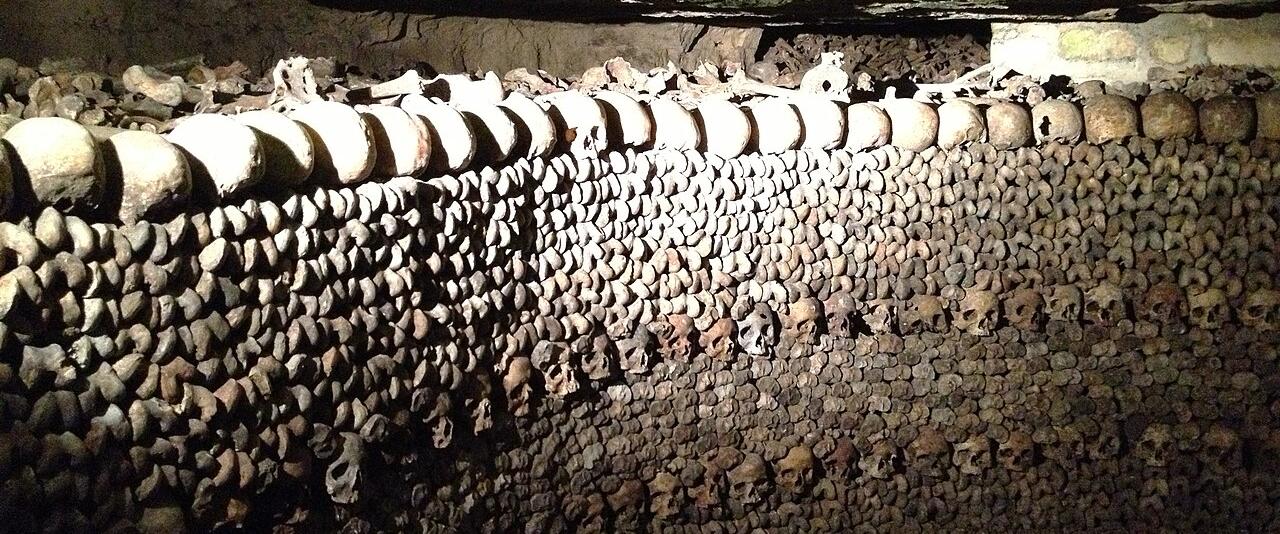
The solution was to move the dead underground. Paris sits on old limestone quarries, and from 1785, the bones of the Innocents and later of other city cemeteries were carried by night to the tunnels. The ossuary was consecrated on 7 April 1786. Transfers continued for decades, until more than six million people lay in the Catacombs, their bones stacked into walls of skulls and thigh bones.
 A 19th-century engraving of the ossuary in the Paris Catacombs. Image: , CC0, via Wikimedia Commons.
The Catacombs have their own legend. In 1793 a man named Philibert Aspairt is said to have got lost in the quarries; his body was found eleven years later, identified by his keys. Records show such a man existed, but the details do not match well, and the police report burned in 1871. Treat the story as documented but murky.
Where to see it today:
- The Catacombs: the entrance is at 1 avenue du Colonel-Henri-Rol-Tanguy, at Place Denfert-Rochereau, and the exit at 21 bis avenue René-Coty. The visit goes about 20 metres underground, down 131 steps and up 112, at a constant 14°C. Book a timed ticket online in advance.
- The Fontaine des Innocents, from 1549, is the last remnant of the cemetery's surroundings. It stands on Place Joachim-du-Bellay, by the Forum des Halles.
 The Fontaine des Innocents, the last trace of the cemetery that once filled this square. Image: DiscoA340, CC BY-SA 4.0, via Wikimedia Commons.
Revolution and Terror, 1789–1794
The Revolution began with a prison. On 14 July 1789, crowds stormed the Bastille fortress and freed the seven prisoners it held. The building was soon demolished.
The guillotine became the Revolution's symbol. In total, 2,498 people were guillotined in Paris: 1,119 on the Place de la Révolution (today's Place de la Concorde), 1,306 at the Barrière du Trône (today's Place de la Nation), and 73 at the Bastille. Louis XVI was executed on the Place de la Révolution on 21 January 1793, and Marie Antoinette on 16 October 1793.
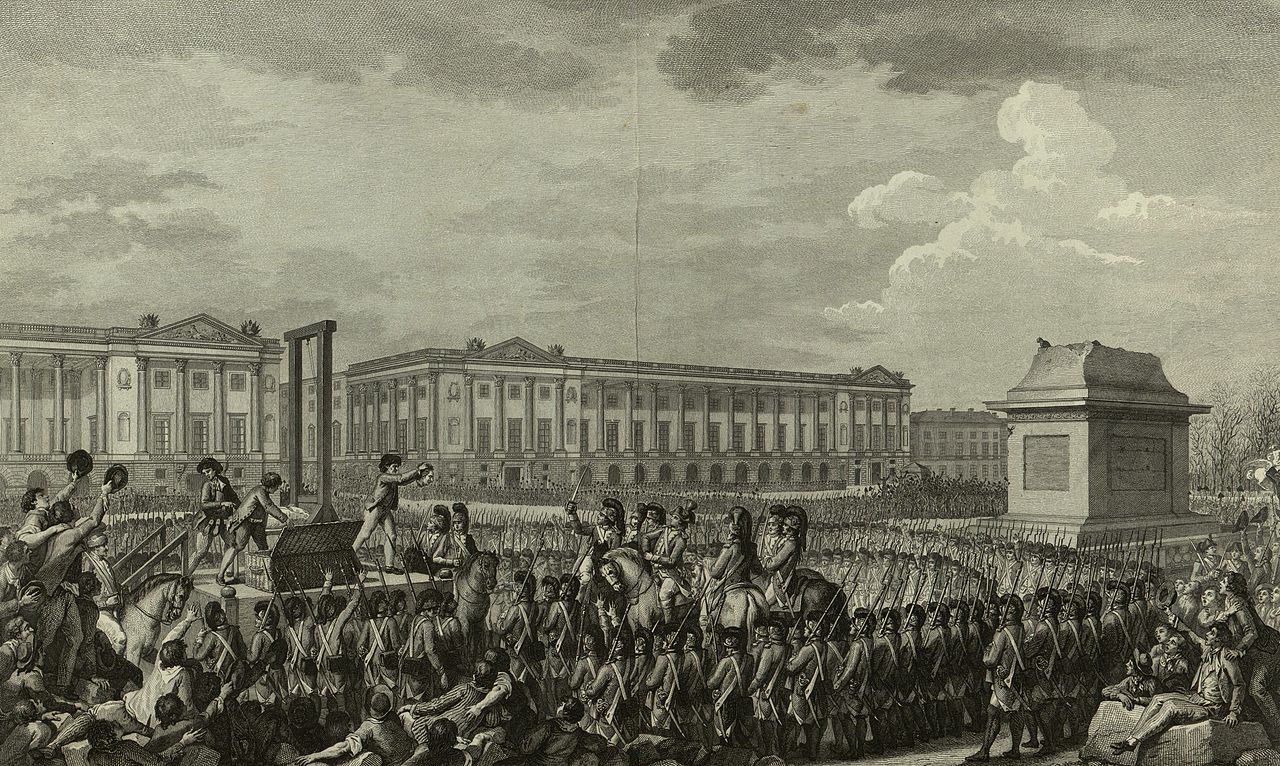 The execution of Louis XVI on the Place de la Révolution, 21 January 1793. Image: Isidore Stanislas Helman / After Charles Monnet, Public domain, via Wikimedia Commons.
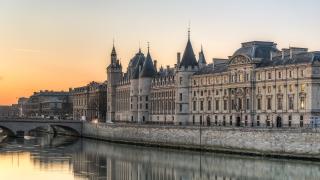
Before execution, most of the condemned passed through the Conciergerie, the medieval palace on the Île de la Cité that became the prison of the Revolutionary Tribunal. Marie Antoinette was moved there in August 1793 and spent her last weeks in a cell before her trial.
 The reconstructed cell of Marie Antoinette in the Conciergerie. Image: Pierre Poschadel, CC BY-SA 3.0, via Wikimedia Commons.
In the summer of 1794, at the height of the Terror, the guillotine was moved to the Barrière du Trône on the eastern edge of the city. In six weeks between June and July 1794, 1,306 people were executed there. Their bodies were carted to a garden nearby and thrown into two mass graves. Among them were sixteen Carmelite nuns from Compiègne, guillotined on 17 July 1794.
 The marker over one of the mass graves at Picpus: "about 304 martyrs beheaded at the Place du Trône in June 1794 rest here". Image: Antoine Rex, CC0, via Wikimedia Commons.
Where to see it today:
- Place de la Concorde, where Louis XVI died; one of its fountains stands roughly where his guillotine was placed.
- The Conciergerie, on boulevard du Palais, with the Hall of Names listing those sentenced by the Revolutionary Tribunal, recreated cells and a chapel built on the site of Marie Antoinette's cell.
- Picpus Cemetery, 35 rue de Picpus (12th), where the mass graves are marked. The Marquis de Lafayette is buried there too, under an American flag that is always flying. It opens for a few hours in the afternoon and is closed on Sundays.
- The Bastille: the outline of the fortress is marked in the paving of Place de la Bastille. Foundations of one of its towers, found during metro works in 1899, were rebuilt in Square Henri-Galli by the Seine, and part of the moat wall is visible on the platform of metro line 5 at Bastille station.
Cholera, 1832
In 1832, cholera killed about 18,400 Parisians in a few months, including the prime minister, Casimir Perier. The epidemic hit the crowded, poorer districts hardest, and anger at the government helped spark the uprising of June 1832, the rebellion Victor Hugo later set at the heart of Les Misérables.
Bloody Week, 1871
After France lost the war with Prussia, Paris rose against the national government in March 1871 and set up its own revolutionary government, the Paris Commune. On 21 May the French army fought its way back into the city. The street fighting and mass executions of the following seven days, the Semaine sanglante or Bloody Week, were the deadliest episode in modern Paris. The army lost 877 men. Estimates of Communards killed range from about 10,000 to 15,000, based on cemetery records, up to 20,000 or 30,000 in accounts from the time.
On 28 May, the last fighters were cornered in Père Lachaise Cemetery, and 147 of them were shot against one of the cemetery's walls.
 The Communards' Wall in Père Lachaise, photographed by Eugène Atget in 1900. Image: Eugène Atget, Public domain, via Wikimedia Commons.
The Commune also explains the city's most famous church. In 1873, the National Assembly backed the construction of the Sacré-Cœur on Montmartre, the hill where the uprising had begun, as an act of national expiation. Built between 1875 and 1914 and consecrated in 1919, it was seen for decades by the French left as a monument to the Commune's defeat.
Where to see it today: the Mur des Fédérés (Communards' Wall) in Père Lachaise Cemetery, where a commemoration is held every year at the end of May.
The Bazar de la Charité Fire, 1897
On 4 May 1897, a charity sale for Paris high society was under way in a wooden hall on rue Jean-Goujon. A projectionist's ether lamp, lighting a showing of the new cinematograph, caught fire. The hall burned in minutes. 126 people died, most of them women from aristocratic families, including the Duchess of Alençon, sister of Empress Elisabeth of Austria.
 The Bazar de la Charité fire on the cover of Le Petit Journal, May 1897. Image: Osvaldo Tofani / Fortuné Méaulle, Public domain, via Wikimedia Commons.
Where to see it today: a memorial chapel, Notre-Dame-de-Consolation, was built on the site in the 8th arrondissement.
Occupation, 1940–1944
German troops entered Paris on 14 June 1940 and held it for four years. The occupiers' security services set up in elegant buildings in the west of the city. At 84 avenue Foch, the SD interrogated captured British agents and French resisters. On 22 March 1944 the resistance leader Pierre Brossolette threw himself from an upper window there rather than risk talking under torture. The Hôtel Lutetia on boulevard Raspail housed German military intelligence; in 1945 it became the reception centre for deportees returning from the camps.
On 16 and 17 July 1942, French police arrested 13,152 Jews in Paris, more than 4,000 of them children, in the Vel d'Hiv roundup. Families were held for about five days in the Vélodrome d'Hiver, an indoor cycling track, in terrible conditions, then sent to camps at Drancy, Pithiviers and Beaune-la-Rolande, and from there to Auschwitz. Very few came back. For decades France described the roundup as a German crime. In 1995 President Jacques Chirac acknowledged the responsibility of the French state, and in 2017 President Emmanuel Macron said: "Not a single German took part."
 The Wall of Names at the Mémorial de la Shoah in the Marais. Image: Ninaraas, CC BY 4.0, via Wikimedia Commons.
The city also had a murderer who used the occupation as cover. Dr Marcel Petiot offered Jews and others a fake escape route out of France, at 25,000 francs a person, then killed them in his house at 21 rue Le Sueur, near the Arc de Triomphe. Neighbours complained of smoke from the chimney, and on 11 March 1944 police found human remains inside. Petiot was convicted of 26 murders and guillotined on 25 May 1946.
Where to see it today:
- The Mémorial de la Shoah, 17 rue Geoffroy-l'Asnier in the Marais, with the Wall of Names listing Jews deported from France. Free; closed on Saturdays.
- The Vel d'Hiv memorial on quai de Grenelle, near Bir-Hakeim metro. The velodrome itself was demolished in 1959.
- The Drancy memorial, in the northern suburbs, opposite the housing estate that served as the transit camp.
17 October 1961
During the Algerian War of Independence, Algerians in the Paris area were placed under a curfew. On the evening of 17 October 1961, between 30,000 and 40,000 of them marched peacefully against it. The police, under prefect Maurice Papon, attacked the marchers. About 11,000 people were arrested, and an unknown number were killed, some of them thrown into the Seine. Official inquiries later documented around 30 to 50 deaths; historians who used other sources estimate 200 or more.
For decades the massacre was barely acknowledged. Papon went on to a long political career. In 1998 he was convicted of crimes against humanity, but for his role in deporting Jews during the occupation, not for 1961.
 The plaque by Pont Saint-Michel: "In memory of the many Algerians killed during the bloody repression of the peaceful demonstration of 17 October 1961." Image: FSouici, CC BY-SA 4.0, via Wikimedia Commons.
Where to see it today: a plaque unveiled in 2001 at Pont Saint-Michel, opposite Notre-Dame. In 2021 President Macron called the events "unforgivable crimes".
Pont de l'Alma, 1997
Shortly after midnight on 31 August 1997, the car carrying Diana, Princess of Wales, and Dodi Fayed crashed into a pillar in the underpass beneath Place de l'Alma while being chased by photographers. Fayed and the driver, Henri Paul, died at the scene; Diana died in hospital a few hours later. A British inquest in 2008 found that she was unlawfully killed through the gross negligence of the driver and the pursuing photographers.
Where to see it today: the Flame of Liberty above the tunnel, a gift from the International Herald Tribune in 1989 that has become an unofficial memorial to Diana. The square around it was named Place Diana in 2019.
2015
On 7 January 2015, two gunmen attacked the offices of the satirical magazine Charlie Hebdo at 10 rue Nicolas-Appert, killing 12 people, including several of its best-known cartoonists and Ahmed Merabet, a police officer shot on the pavement outside. Two days later, an accomplice killed four Jewish hostages at the Hypercacher supermarket at Porte de Vincennes.
On the evening of 13 November 2015, coordinated attacks on the Stade de France, on bars and restaurants in the 10th and 11th arrondissements and on the Bataclan concert hall killed 130 people, 90 of them at the Bataclan.
Where to see it today: the Jardin du 13-Novembre, a memorial garden on Place Saint-Gervais beside the Hôtel de Ville, opened in 2025. It has a granite block for each site attacked and the names of the victims, and is free and open at all hours.
Modern Paris's Dark Side
- The Louvre heist: on the morning of 19 October 2025, thieves used a furniture lift to reach a balcony of the Galerie d'Apollon, cut their way in and left with nine pieces of the French crown jewels in under eight minutes. They dropped one, Empress Eugénie's crown. The other eight, worth about €88 million, had not been recovered at the time of writing. Several suspects have been charged, the museum's director resigned in February 2026, and the gallery reopened in July 2026.
- Pickpockets: staff walked out over pickpocket gangs at the Louvre in 2013 and at the Eiffel Tower in 2015, closing both for the day. Keep valuables zipped away in crowds, on the metro and around the big sights.
- Prices: since January 2026, most visitors from outside the EU pay €32 to enter the Louvre instead of €22.
- "Paris Syndrome", the shock some visitors feel when the city doesn't match their expectations, was described by a Japanese psychiatrist in the 1980s. It is not a recognised diagnosis, but you may still recognise the feeling on a rainy day at Châtelet.
How to See Dark Paris Respectfully
A self-guided walk, about 4.5 km. Start at Place de la Bastille, where the fortress outline is marked in the paving, and walk to Square Henri-Galli for the tower foundations. Continue to the Mémorial de la Shoah in the Marais, then to the Place de l'Hôtel-de-Ville, the old Place de Grève, with the Jardin du 13-Novembre beside it. Cross to the Île de la Cité for the Conciergerie, see the 1961 plaque at Pont Saint-Michel, then cross back to Saint-Germain-l'Auxerrois and the Coligny monument behind the Oratoire on rue de Rivoli. Finish at the Fontaine des Innocents in Les Halles.
Further afield:
- The Catacombs at Denfert-Rochereau (book ahead).
- Père Lachaise, for the Communards' Wall.
- Picpus Cemetery, near Nation.
- Place de la Concorde.
- The Vel d'Hiv memorial near Bir-Hakeim.
- The Flame of Liberty at Pont de l'Alma.
- The site of the Gibbet of Montfaucon, near Colonel Fabien metro.
- Sacré-Cœur, seen with the history of the Commune in mind.
Dates the city remembers:
- 7 January: the Charlie Hebdo attack.
- Late May: the Commune, at the Communards' Wall.
- Mid-July: the Vel d'Hiv roundup.
- 17 October: the 1961 massacre.
- 13 November: the 2015 attacks.
A few ground rules. The 20th- and 21st-century memorials honour people whose families still live in Paris, and the 2015 sites are still raw for many. Keep your voice down and don't pose for photos at them. In the Catacombs, don't touch or move the bones; it is a burial place as well as a museum.


,_Conciergerie,_cachot_de_Marie-Antoinette_1.jpg)


