The Alsace Wine Route (Route des Vins d'Alsace) runs for more than 170 km from Marlenheim, west of Strasbourg, to Thann, west of Mulhouse, along the eastern foothills of the Vosges. The Alsace tourism board counts almost 119 wine-growing towns and villages on or near it and about 720 producers who welcome visitors. The route was inaugurated on 30 May 1953.
The road zig-zags from village to village through the vineyards, so the signposted route is longer than the straight drive: by OpenStreetMap routing, Marlenheim to Thann is about 119 km on the fastest roads, and about 148 km if you go through the villages in this guide. Most people do not drive it end to end. They pick one stretch, usually the central part around Colmar, and spend two to four days there.
Quick facts (checked November 2026)
- Start and end: Marlenheim (north) to Thann (south), more than 170 km.
- Launched: 30 May 1953. Two parades, one from the north and one from the south, met in Ribeauvillé.
- Grands Crus: 51 classified vineyard sites, recognised from 1975 onward.
- By bike: the Alsace Vineyard Cycle Route, part of EuroVelo 5. The tourism board gives it as 131.5 km and the official cycling site as 140 km, Marlenheim to Thann.
- On foot: more than 50 vineyard trails (sentiers viticoles) have been created since 1993, with information panels along the way.
- Without a car: TER trains stop at Molsheim, Rosheim, Obernai, Barr, Dambach-la-Ville, Turckheim and Thann. Fluo coaches from Colmar reach Riquewihr, Ribeauvillé, Kaysersberg and Eguisheim.
- Best base without a car: Colmar, which has trains, regular buses, the Kut'zig hop-on hop-off bus from April to October, and the Christmas shuttles (27 November–20 December 2026).
The route at a glance
Distances and times are by OpenStreetMap routing between town centres on the shortest road. They are rounded, and the times are optimistic, so allow more time for village traffic and parking.
| Stage | Distance | Drive | Stops worth the time |
|---|---|---|---|
| Strasbourg → Marlenheim (start) | about 22 km | about 25 min | Start of the route |
| Marlenheim → Obernai | about 23 km | about 25 min | Obernai old town, Mont Sainte-Odile (half a day) |
| Obernai → Barr → Mittelbergheim → Andlau | about 13 km | about 20 min | Mittelbergheim, Andlau abbey (2–3 hours) |
| Andlau → Dambach-la-Ville | about 10 km | about 15 min | Small medieval town (1 hour) |
| Dambach-la-Ville → Bergheim → Ribeauvillé | about 24 km | about 25 min | Bergheim ramparts, Ribeauvillé (half a day) |
| Ribeauvillé → Hunawihr → Riquewihr | about 7 km | about 11 min | Hunawihr church, Riquewihr (half a day) |
| Riquewihr → Kaysersberg | about 10 km | about 14 min | Kaysersberg bridge and castle (2–3 hours) |
| Kaysersberg → Turckheim → Eguisheim | about 17 km | about 24 min | Turckheim, Eguisheim (half a day) |
| Eguisheim → Rouffach → Guebwiller | about 23 km | about 27 min | Southern vineyards |
| Guebwiller → Thann (end) | about 23 km | about 24 min | Rangen vineyard walk (1.5 hours) |
From Colmar, the main village stops are close: Eguisheim and Turckheim are each about 7 km away, Kaysersberg about 12 km, Riquewihr about 16 km and Ribeauvillé about 18 km.
Where the route runs
The Alsace tourism board divides the wine route into five parts, and it helps to know them because the Marlenheim–Thann stretch covers only four:
- Strasbourg vineyards (Marlenheim to Molsheim): the northern gateway to the route itself.
- Centre Alsace: between Strasbourg and Colmar, with Obernai, Barr, Andlau, Dambach-la-Ville and the castle of Haut-Koenigsbourg on the ridge above.
- Colmar vineyards: Ribeauvillé, Riquewihr, Kaysersberg, Turckheim and Eguisheim. Most visitors go here, and the tourism board calls Colmar the capital of Alsace wine.
- Southern route (Thann to Soultzmatt): steeper slopes below the Grand Ballon, the highest point of the Vosges. Guebwiller has four Grands Crus and Thann has the Rangen.
- Northern Alsace (Wissembourg and Cleebourg): about 60 km north of Strasbourg near the German border. The tourism board counts it as a stop on the wine route, and it has the most northerly vineyards in Alsace, but it lies well north of the Marlenheim–Thann stretch and is a separate trip.
The villages in order, north to south
Marlenheim is where the route starts, about 22 km west of Strasbourg. If your time is short, skip ahead to Obernai.
Obernai is the largest town on the northern part of the route. Its train station is 500 m from the centre, so it works as a base without a car. Above the town is Mont Sainte-Odile, a pilgrimage convent dedicated to St Odile, the patron saint of Alsace. The plateau is enclosed by the Pagan Wall, a dry-stone wall 11 km long whose origin is still disputed. The Obernai tourist office points to bus line 257 for the trip up.
Barr is a wine town on the same railway line. Its Kirchberg de Barr is one of three Grands Crus where Pinot Noir is now allowed: it and Hengst at Wintzenheim, near Colmar, since the 2022 vintage, and Vorbourg at Rouffach since 2024.
Mittelbergheim, about 2 km from Barr, is one of five wine-route villages in the Plus Beaux Villages de France association. It looks different from the half-timbered villages further south: its estates have Renaissance houses in pink sandstone and arched porches. Its Zotzenberg is the only Grand Cru where Sylvaner is classified. The village usually holds its wine festival on the last weekend of July and a new-wine festival on the second weekend of October.
Andlau, about 3 km further on, is known for its large abbey church. It has three Riesling Grands Crus: Moenchberg, Kastelberg and Wiebelsberg. The nearest station, Eichhoffen, is about 2.5 km away by road.
Dambach-la-Ville is a small medieval town with its own station on the Strasbourg–Sélestat line via Barr. From here the route continues south past Sélestat, below Haut-Koenigsbourg, into the Haut-Rhin.
Bergheim keeps its town walls. It is another Plus Beaux Villages member, with two Grands Crus: Altenberg de Bergheim, one of the two where blends are allowed, and Kanzlerberg, one of the smallest. A Gewurztraminer festival is held in July.
Ribeauvillé, about 4 km south, has ruined castles on the wooded slope above the town, the highest being the Château du Haut-Ribeaupierre. Fluo bus 817 runs from Colmar.
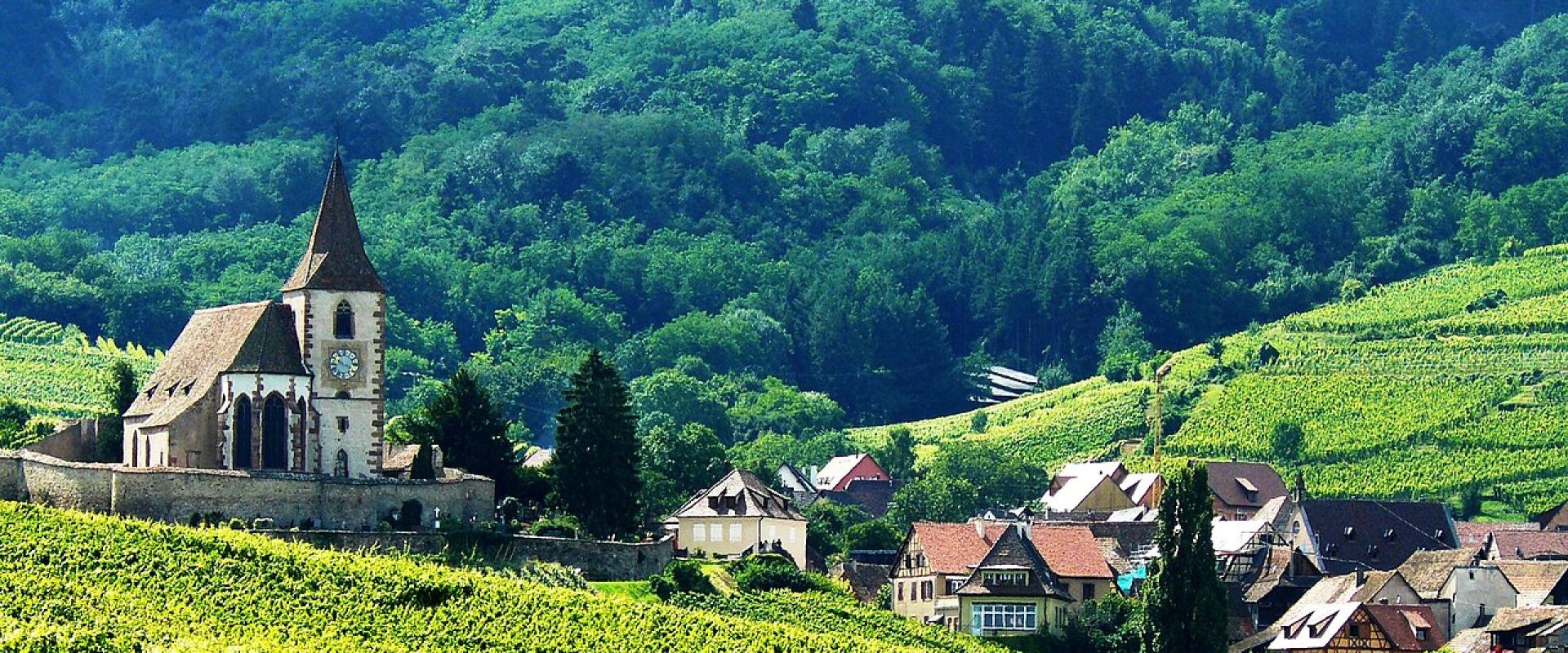
Hunawihr, 2 km on, is the classic view of the route: a fortified church surrounded by vines. The village has the Rosacker Grand Cru and a centre for reintroducing storks and otters. Neighbouring Zellenberg sits on a hill, where two towers remain from its castle.
Riquewihr, about 5 km from Hunawihr, keeps its medieval layout. Its ramparts are still standing, and the Tour des Voleurs, a 14th-century former prison, stands next to a 16th-century winegrower's house with its period interior, cellar and tools. Its Grands Crus are Sporen and Schoenenbourg.
Kaysersberg, about 10 km from Riquewihr, was voted the French public's favourite village in 2017. It is the birthplace of Albert Schweitzer, winner of the Nobel Peace Prize. A fortified bridge over the Weiss lies below the 13th-century Schlossberg castle. The town is now part of the commune of Kaysersberg Vignoble, which is the name used on bus timetables.
Turckheim, about 9 km south, lies on the railway from Colmar towards Munster. Its Grand Cru is the Brand. The town still has a night watchman: its 2024 programme listed rounds at 22:00 from the Corps de Garde every evening from 1 May to 31 October. In the Christmas season the rounds start at 21:00 (1–23 and 26–30 December 2026). Check the current season's times before you go.
Eguisheim, about 8 km away, is built in concentric rings of streets around its castle. It was voted the French public's favourite village in 2013 and is a Plus Beaux Villages member. About thirty winegrowers work in the village, which has two Grands Crus: Eichberg and Pfersigberg. Bus or car, it is about 7 km from Colmar.
Rouffach and Guebwiller begin the quieter southern section. Rouffach's Vorbourg is one of the three Grands Crus allowed for Pinot Noir, and Guebwiller has four Grands Crus.
Thann ends the route. The Rangen above the town is described by the tourism board as the steepest vineyard in Alsace. A loop through it is about 4 km on dirt paths, climbs about 180 m and takes about 1 hour 30 minutes, so wear walking shoes. A tram-train runs to Thann from Mulhouse, about 22 km away.
Driving the route
Driving gives you the most freedom: you can stop at any of the hundreds of producers and reach villages without a station. Practical points:
- Plan stages, not the whole route. At village pace, the central section from Ribeauvillé to Eguisheim fills a full day, and the northern section from Obernai to Dambach-la-Ville fills another.
- Park outside the old centres. Riquewihr, Kaysersberg and Eguisheim have car parks at the edge of the old town. Eguisheim's tourist office lists daily rates and short blue-zone limits in the centre.
- Decide who is driving before the first tasting. France's legal limit is 0.5 g of alcohol per litre of blood (0.25 mg per litre of breath). From 0.8 g/L it is a criminal offence.
Cycling: the Alsace Vineyard Cycle Route
The Véloroute du Vignoble d'Alsace runs from Marlenheim to Thann, roughly parallel to the wine road. It is part of EuroVelo 5, the Via Romea. The Alsace tourism board gives it as 131.5 km in five stages:
- Marlenheim to Obernai
- Obernai to Sélestat
- Sélestat to Colmar
- Colmar to Guebwiller
- Guebwiller to Thann
The official cycling site, cyclinginalsace.com, gives 140 km over four days and three nights, at a difficulty it calls "regular practice". It has GPX and KML files to download. The route uses old railway lines, part of a Roman road and quiet lanes.
Trains make one-way rides easy. From Strasbourg, take the train to Molsheim or Obernai. From Colmar, take the Munster line to Turckheim. From Mulhouse, take the tram-train to Thann. The tourism board suggests spring to autumn for cycling.
Walking: the sentiers viticoles
There is no single famous end-to-end footpath. Walking on the wine route means the sentiers viticoles: signposted vineyard trails, mostly loops of an hour or two from a village, with panels about grape varieties, soils and the Grands Crus. More than 50 were created from 1993 onward. Good ones to start with:
- Eguisheim: an easy vineyard trail through the Eichberg and Pfersigberg Grands Crus.
- Thann: the Rangen loop described above, the steepest of them.
- Riquewihr, Hunawihr and Ribeauvillé: the three villages are about 2 to 5 km apart by road, so with the bus between Colmar and Ribeauvillé or Riquewihr you can walk one way between them through the vines.
Ask at the local tourist office for the current trail map, and stay on marked paths: the vines are private property and working land, especially at harvest time.
Grands Crus in brief
Alsace has 51 Grand Cru sites, each a named vineyard with its own boundaries. The INAO classified them from 1975 to 2007, and their names were registered for protection in October 2011. Grands Crus make up about 4% of Alsace wine.
As a rule, Grand Cru wines come from four white grapes: Riesling, Muscat, Pinot Gris and Gewurztraminer. There are exceptions. Altenberg de Bergheim and Kaefferkopf allow blends, and Zotzenberg allows Sylvaner. Since the 2022 vintage, Pinot Noir has also been allowed in Hengst and Kirchberg de Barr, and since 2024 in Vorbourg at Rouffach.
On a label, the vineyard name comes after "Alsace Grand Cru". The Grands Crus along this route include Kirchberg de Barr (Barr), Zotzenberg (Mittelbergheim), Moenchberg, Kastelberg and Wiebelsberg (Andlau), Altenberg de Bergheim and Kanzlerberg (Bergheim), Rosacker (Hunawihr), Sporen and Schoenenbourg (Riquewihr), Brand (Turckheim), Eichberg and Pfersigberg (Eguisheim), and Rangen (Thann).
Visiting winegrowers
About 720 producers on the route welcome visitors, according to the Alsace tourism board. Conditions vary by estate, and no official source publishes standard tasting prices, so ask whether there is a fee when you arrange a visit. Small family estates are working farms: phone or email ahead, particularly in the harvest season and if you come as a group. Tourist offices also list bookable tastings, cellar visits and vineyard picnics.
When to go
- April to October: the main season. The Kut'zig hop-on hop-off bus runs in these months, and the cycle route is at its best.
- July and August: village wine festivals, such as Mittelbergheim's (usually the last weekend of July) and Bergheim's Gewurztraminer festival in July.
- September and October: the harvest. The tourism board lists the vin nouveau in September and harvest festivals through the autumn. Its Fascinant Weekend of wine events has been held on the third weekend of October since 2020, so check the 2027 programme.
- Late November to December: the Christmas markets. In 2026 Riquewihr's runs daily from 27 November to 20 December. Kaysersberg's runs Friday to Sunday on four weekends from 27 November to 20 December. Eguisheim's runs from 27 November to 30 December, closed 24–26 December. Ribeauvillé holds a medieval market on 5–6 and 12–13 December. See our guides to the Alsace Christmas villages and the Colmar Christmas markets.
- January to March: the quietest months. The Kut'zig bus does not run, so this is a time to travel by car or train and contact estates ahead.
Getting there without a car
By train. Strasbourg–Colmar trains take 26 minutes at the fastest (TGV) and about 31 minutes on average, with about 40 departures on a weekday in November 2026; TER trains stop at Sélestat. A slower TER line runs from Sélestat to Strasbourg through the wine villages. It stops at Dambach-la-Ville, Epfig, Eichhoffen, Barr, Obernai, Rosheim and Molsheim, and takes about 1 hour to 1 hour 20 minutes end to end. From Colmar, trains run to Turckheim on the Munster–Metzeral line. From Mulhouse, the tram-train runs to Cernay and Thann. Plan journeys on the TER Grand Est or SNCF Connect website.
By bus. Fluo renumbered its Haut-Rhin coach lines on 1 September 2026, so old timetables and blog posts show different numbers. The current lines from Colmar:
- 816 Colmar–Riquewihr–Ribeauvillé centre.
- 817 Colmar–Ribeauvillé–Saint-Hippolyte.
- 813 to Kaysersberg, Monday to Saturday except public holidays.
- Eguisheim: the Colmar–Eguisheim–Rouffach line, 68R030 in the 2025–26 timetable. It ran Monday to Saturday with no Sunday service, and its current number is on fluo.grandest.fr.
- Turckheim: Colmar's town buses (Trace) also run there.
- TER coach: links Sélestat with Ribeauvillé and Riquewihr on Sundays and public holidays.
Check timetables on fluo.grandest.fr before you go: many lines run only a few times a day.
By hop-on hop-off bus. Kut'zig's open-top bus loops from opposite Colmar station through Ribeauvillé, Hunawihr, Riquewihr, Kaysersberg Vignoble, Turckheim and Eguisheim from April to October. Booking is required, and a day ticket was listed from €32 in November 2026. It covers only the Colmar section, not the whole route.
At Christmas. From 27 November to 20 December 2026, Christmas shuttles leave Colmar station. Lines 1 and 2 serve Kaysersberg, Riquewihr and Ribeauvillé from Friday to Sunday for €17 a day. Line 3 serves Eguisheim every day for €8 Monday to Thursday and €17 Friday to Sunday. Tickets go on sale on 12 November 2026.
Where to base yourself
- Colmar: best for a first visit without a car. Trains go to Strasbourg and Mulhouse, buses go to the main villages, and the Kut'zig and Christmas shuttles leave from the station. Eguisheim and Turckheim are each about 15 minutes away.
- Riquewihr, Ribeauvillé, Kaysersberg or Eguisheim: best with a car or bike, so you can see the villages early and late, before and after the day visitors. Ribeauvillé has the most services of the four.
- Obernai: best for the northern section (Barr, Mittelbergheim, Andlau, Mont Sainte-Odile). It has a station 500 m from the centre and trains to Strasbourg.
- Strasbourg: a day trip to Obernai and Barr works by train, but the central villages are a long day from Strasbourg without a car.
- Mulhouse or Thann: for the quieter southern section and the Rangen.
Practical notes
- Getting there: Strasbourg and Colmar have TGV and TER stations. Colmar and Obernai are the easiest bases without a car.
- Road: the route itself uses local roads through the villages. The fastest drive from Marlenheim to Thann is about 119 km.
- Buses: Fluo Haut-Rhin line numbers changed on 1 September 2026, so use the current timetables on fluo.grandest.fr, not printed leaflets from earlier years.
- Bikes: the vineyard cycle route is 131.5–140 km depending on the source, with GPX tracks on cyclinginalsace.com.
- Drinking and driving: the limit in France is 0.5 g/L of blood, and 0.2 g/L for drivers in their probationary period.
- Accuracy: dates, timetables and prices are as published by the organisers, tourist offices and transport operators in November 2026. Check them before you travel.