Limoges Beyond Tableware
Limoges is famous for porcelain, but the same industrial wealth that built its kilns also paid for some of the most interesting early 20th-century architecture in central France. Between about 1900 and 1930 the city gained a porcelain museum with Art Nouveau galleries, a market hall decorated with ceramics, a former cold store covered in mosaics, and a railway station that many people consider among the most beautiful in the country. Most of it sits within walking distance of the centre, which makes Limoges an easy place to follow the move from the curving lines of Art Nouveau to the stricter geometry of Art Deco.
Musée National Adrien Dubouché
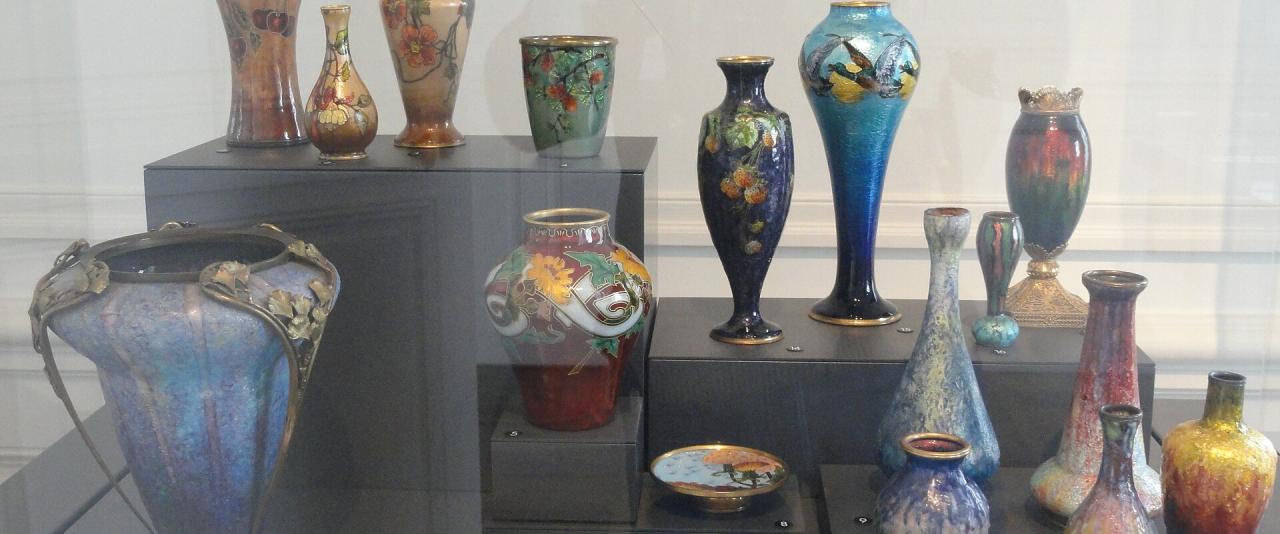
The national porcelain museum is the natural starting point. Founded in 1845 and named after Adrien Dubouché, a local benefactor who sat on the ceramics jury of the 1878 Paris Exposition Universelle, it became a national institution in 1881. Its historic building was constructed between 1896 and 1900, and the route through the museum still passes through the original Art Nouveau-era galleries from 1900.
In 2012 the museum reopened after a full renovation by the architect Boris Podrecca, who added a contemporary extension. Today it holds more than 18,000 works, around 5,000 of them on display, and is described as the largest public collection of Limoges porcelain in the world. The displays trace ceramics from antiquity to the present, so you can see the porcelain of the Art Nouveau and Art Deco years in the context of what came before and after. Allow at least two hours.
Gare des Bénédictins
Limoges-Bénédictins station is the city's best-known 20th-century landmark. Designed by the architect Roger Gonthier, with work beginning in 1924, it combines a copper dome and a tall clock tower with carved limestone decoration by the sculptor Henri Frédéric Varennes. It is often described as Art Nouveau, though its date and geometric detail place it at the crossover into Art Deco. Inside, look up at the stained glass by Francis Chigot, the Limoges glassmaker whose work appears in several buildings in the city. The station has been a listed historic monument since 1975, and you can admire the main hall simply by walking in. For the classic photograph, view it from the bridge over the tracks or from the gardens nearby.
Pavillon du Verdurier
A short walk from the station, the Pavillon du Verdurier at 15 rue du Collège is one of Limoges' small surprises. Built in 1919, also by Roger Gonthier, it began life as a refrigerated pavilion for imported meat, later became a covered market and then a bus station from 1942 to 1976. Its reinforced-concrete octagon is covered in mosaics and ceramic stoneware in a clearly Art Deco style, with interior decoration by Léonard Chigot, Francis Chigot's father. Restored by the city in 1978, it now hosts temporary exhibitions, so opening times depend on what is on.
Les Halles Centrales
On Place de la Motte, the covered market is an iron-and-glass hall from the late 19th century, designed by engineers who had worked in Gustave Eiffel's circle. Its most distinctive feature for porcelain lovers is the ceramic frieze running around the building, a reminder of the city's industry. The hall reopened in November 2019 after renovation and remains a working food market, which makes it a good stop for lunch.
Four des Casseaux
To see where the porcelain was actually made, visit the Four des Casseaux on rue Victor Duruy. This brick bottle kiln, around 20 metres high, was the central kiln of the Gérard-Dufraisseix-Abbott factory and fired porcelain from the early 20th century until the 1950s. A single firing could hold thousands of pieces. It is now a listed monument and a small museum explaining how kaolin was turned into porcelain, which helps make sense of the finished pieces in the Adrien Dubouché museum.
Planning a Self-Guided Walk
A practical one-day route:
- Morning: start at the Gare des Bénédictins, then walk to the Pavillon du Verdurier.
- Late morning: continue to the Musée national Adrien Dubouché, west of the centre.
- Lunch: head to Les Halles centrales on Place de la Motte, and explore the half-timbered Quartier de la Boucherie next door.
- Afternoon: visit the Four des Casseaux, a little outside the historic centre, by bus or a longer walk.
The Musée des Beaux-Arts, in the former bishop's palace above the river, is another option if you have extra time; it is best known for its collection of Limoges enamels.
Check opening days before you go: French museums often close one day a week, typically Monday or Tuesday, and hours change between summer and winter. The Limoges tourist office can provide maps and information on guided architecture tours.