Why These Two Neighbourhoods
The Marais, spread over the 3rd and 4th arrondissements on the Right Bank, is one of the few parts of central Paris that kept much of its pre-Haussmann street plan. Aristocrats built grand town houses (hôtels particuliers) here in the 17th century, and many survive as museums, archives and libraries. Just across the river, the Île Saint-Louis is a small residential island laid out in the same period. Together they make a compact half-day or full-day walk, entirely on foot.
Place des Vosges and the Southern Marais
Start at the Place des Vosges, inaugurated in 1612 as the Place Royale and the oldest planned square in Paris. Its red brick and stone houses sit above continuous arcades. At number 6, the Maison de Victor Hugo occupies the apartment where the writer lived in the 1830s and 1840s; as a City of Paris museum its permanent collection is free.
From the south-west corner of the square, a passage leads through the garden of the Hôtel de Sully, a 17th-century mansion, to Rue Saint-Antoine. To the west, the Rue Saint-Paul and the Village Saint-Paul, a group of linked courtyards, hold antique and design shops.
Museums in Old Mansions
The Marais has an unusual concentration of museums in historic buildings:
- Musée Carnavalet: the museum of the history of Paris, in two connected mansions on Rue de Sévigné. Entry to the permanent collection is free.
- Musée Picasso: in the Hôtel Salé, with one of the largest collections of the artist's work. Admission is charged.
- Musée Cognacq-Jay: 18th-century art and furniture, free for the permanent collection.
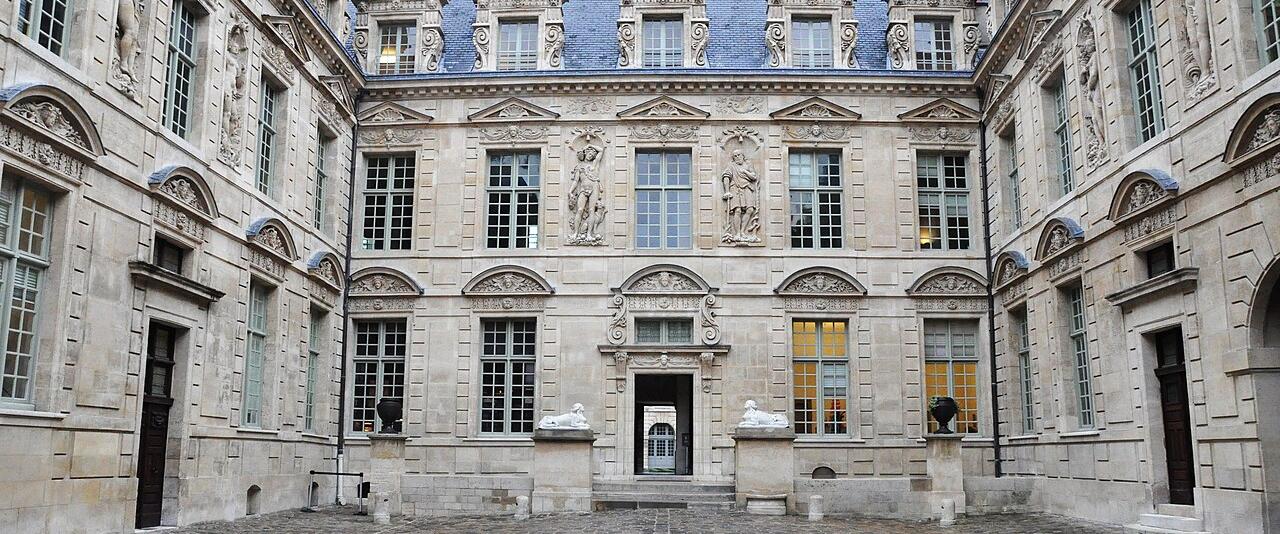
- Archives nationales: in the Hôtel de Soubise, with period interiors open to visitors.
City of Paris museums are generally closed on Mondays, and the Musée Picasso also closes on Mondays, so plan accordingly. The Archives nationales also run a museum of French history in the same buildings, with rotating displays of original documents, and the courtyard of the Hôtel de Soubise is open to walk through even if you do not go inside. A little further east, the Hôtel de Sens, one of the few surviving medieval town houses in Paris, now holds a public library of decorative and fine arts.
The Jewish Quarter and Rue des Rosiers
Rue des Rosiers and the streets around it, known as the Pletzl, have been a centre of Jewish life in Paris since the 19th century. Today the street mixes kosher bakeries, falafel counters and fashion shops. The Mémorial de la Shoah on Rue Geoffroy-l'Asnier, near the river, documents the deportation of Jews from France and has free entry; allow at least an hour. Many shops in the Marais open on Sundays, which makes the area busy at weekends, while some Jewish-owned businesses close on Saturday.
The Northern Marais
The northern part of the district, around Rue de Bretagne and Rue Charlot, is quieter and more local. The Marché des Enfants Rouges, founded in the early 17th century, is considered the oldest covered market in Paris; today it is mostly food stalls where you can eat at shared tables. Check opening days before going, as it closes on Mondays.
Crossing to the Île Saint-Louis
Walk south to the Seine and cross the Pont Marie, one of the oldest bridges in Paris, to the Île Saint-Louis. The island was developed in the 17th century on what had been two islets, and its plain stone facades and quiet quays have changed little since. The main street, Rue Saint-Louis-en-l'Île, runs down the middle, with the church of Saint-Louis-en-l'Île, small shops and the Berthillon ice-cream maker. Expect queues in summer.
Walk the lower quays around the island for views of the Seine. At the western tip, the Pont Saint-Louis leads to the Île de la Cité, where Notre-Dame reopened in December 2024 after the restoration that followed the 2019 fire. The Quai d'Orléans on the island's south side gives a good view of the cathedral's east end.
Practical Tips
- Metro: Saint-Paul (line 1) is handy for Place des Vosges, Chemin Vert (line 8) for the Musée Picasso area, Rambuteau (line 11) for the north, and Pont Marie (line 7) for the island.
- Timing: mornings are the calmest; Sunday afternoons in the Marais are crowded.
- Footwear: pavements are narrow and often cobbled.
- Toilets: free public toilets are available in parts of the area, and museum cafes are another option.