



Autumn is one of the best times to see Paris for anyone who loves art and books. From late September to November, the summer crowds thin, the chestnut trees in the parks turn bronze, and the cultural season restarts with new exhibitions and art fairs. It also rains more often, which is a good excuse to spend long hours in galleries and bookshops. Here is how to plan an autumn trip around both.
What Autumn in Paris Is Like
Expect mild days in September, cooler weather in October and damp, grey days by November, when daytime highs often sit around 10°C. Showers are frequent but rarely last all day, so carry an umbrella and a warm layer. Clocks go back on the last Sunday of October, and from then on it is dark by late afternoon, which suits evenings indoors. The parks are at their most colourful in October: the Jardin du Luxembourg, the Tuileries and the Bois de Vincennes are good for a walk between showers.
Autumn Events for Art Lovers
- European Heritage Days (Journées européennes du patrimoine), on the third weekend of September, open ministries, embassies and private mansions that are normally closed to the public. Popular sites need booking or long queues.
- Fête des Vendanges de Montmartre, in early-to-mid October, celebrates the harvest of the small vineyard on the Butte Montmartre with a parade and food stalls.
- Art Basel Paris, the city's major contemporary art fair, takes place at the Grand Palais in late October, with gallery openings across the city that week.
- Paris Photo, the large photography fair, is held at the Grand Palais in November.
Note that Nuit Blanche, the all-night arts festival, used to be held in early October but moved to the first Saturday of June from 2023.
Museums for a Rainy Day
Paris has far more than the Louvre, and autumn is a good time to see the smaller collections.
- Musée de l'Orangerie, in the Tuileries, displays Monet's huge Water Lilies panels in two oval rooms created to his wishes.
- Musée Marmottan Monet, near the Bois de Boulogne, holds the largest collection of Monet's work, including Impression, Sunrise, the painting that gave Impressionism its name.
- Musée d'Orsay covers 19th-century art in a former railway station.
- Musée Jacquemart-André, a 19th-century private mansion, shows the art collection of the couple who lived there.
The City of Paris also runs several museums whose permanent collections are free, including the Petit Palais, the Musée Carnavalet (the history of Paris), the Musée de la Vie Romantique in a garden house in the 9th arrondissement, and the Maison de Victor Hugo on Place des Vosges. Many museums close one day a week, typically Monday or Tuesday, so check before you go and book timed tickets for the big names.
Bookshops Worth the Detour
- Shakespeare and Company, on the Left Bank opposite Notre-Dame, is the best-known English-language bookshop in Paris. Queues form outside on busy days, so go early or late; its café is next door.
- Galignani, on Rue de Rivoli near the Tuileries, is a long-established bookshop with English and French titles and a strong art and design section.
- Smith & Son, also on Rue de Rivoli near Concorde, is the former WHSmith Paris store, now an independent English-language bookshop.
- The Abbey Bookshop, in a narrow street in the Latin Quarter, is packed floor to ceiling with secondhand English books.
- Librairie Delamain, near the Palais-Royal, is one of the city's oldest bookshops, focusing on French literature.
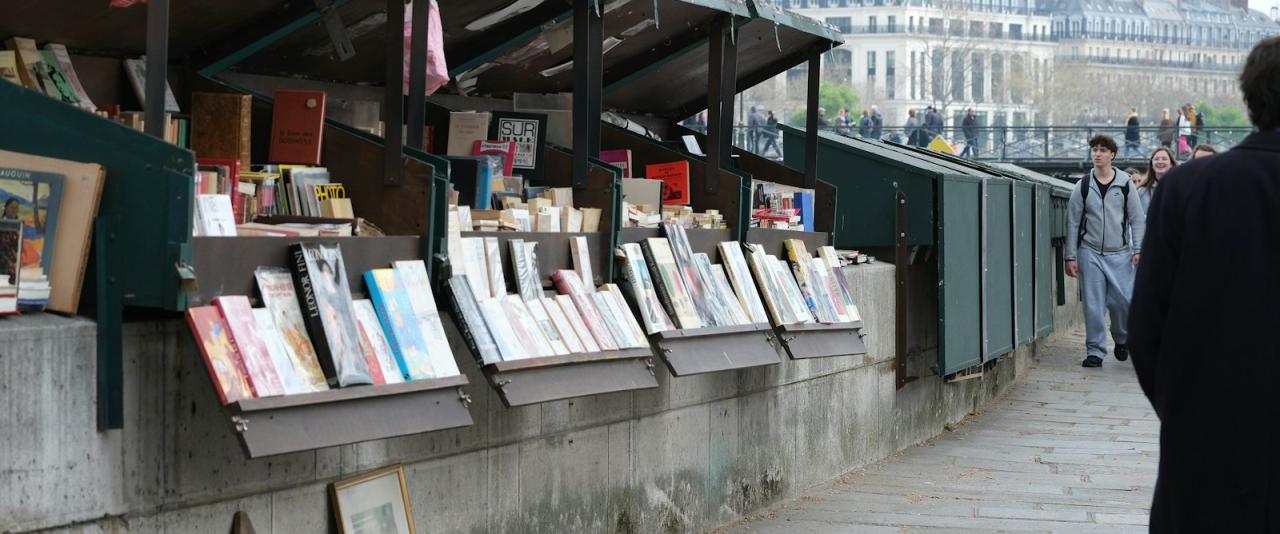
Along the Seine, the green boxes of the bouquinistes sell old books, prints and posters, though many stay shut in heavy rain.
The Covered Passages
On a wet afternoon, walk through the 19th-century covered passages of the Right Bank, which were built as sheltered shopping arcades. Galerie Vivienne, near the Palais-Royal, has mosaic floors and a long-running secondhand bookshop. Passage des Panoramas and Passage Jouffroy continue north towards the Grands Boulevards, lined with small shops selling old books, prints, stamps and toys. Together they make an easy, dry route through the 2nd and 9th arrondissements.
A Two-Day Autumn Plan
Day one: Start at the Musée de l'Orangerie when it opens, walk through the Tuileries, then browse Galignani and Smith & Son on Rue de Rivoli. After lunch, head through the Palais-Royal gardens to Galerie Vivienne and the passages to the north.
Day two: Spend the morning at the Musée d'Orsay, cross to the Left Bank's Latin Quarter for Shakespeare and Company and the Abbey Bookshop, and finish with a walk in the Jardin du Luxembourg if the rain holds off. On a grey day, swap the park for the Musée de Cluny, the museum of the Middle Ages nearby.
Practical Tips
Book timed tickets for the Orangerie, Orsay and any major temporary exhibition, especially on weekends and during the art-fair week in October. Waterproof shoes are worth packing. The metro covers every stop in this plan, and most of the bookshops are within walking distance of each other along Rue de Rivoli and in the Latin Quarter.