







- Admission
- Free entry
- Hours
- Open year-round, 24/7
- Where
- Etretat, Normandy
- Directions
- Directions
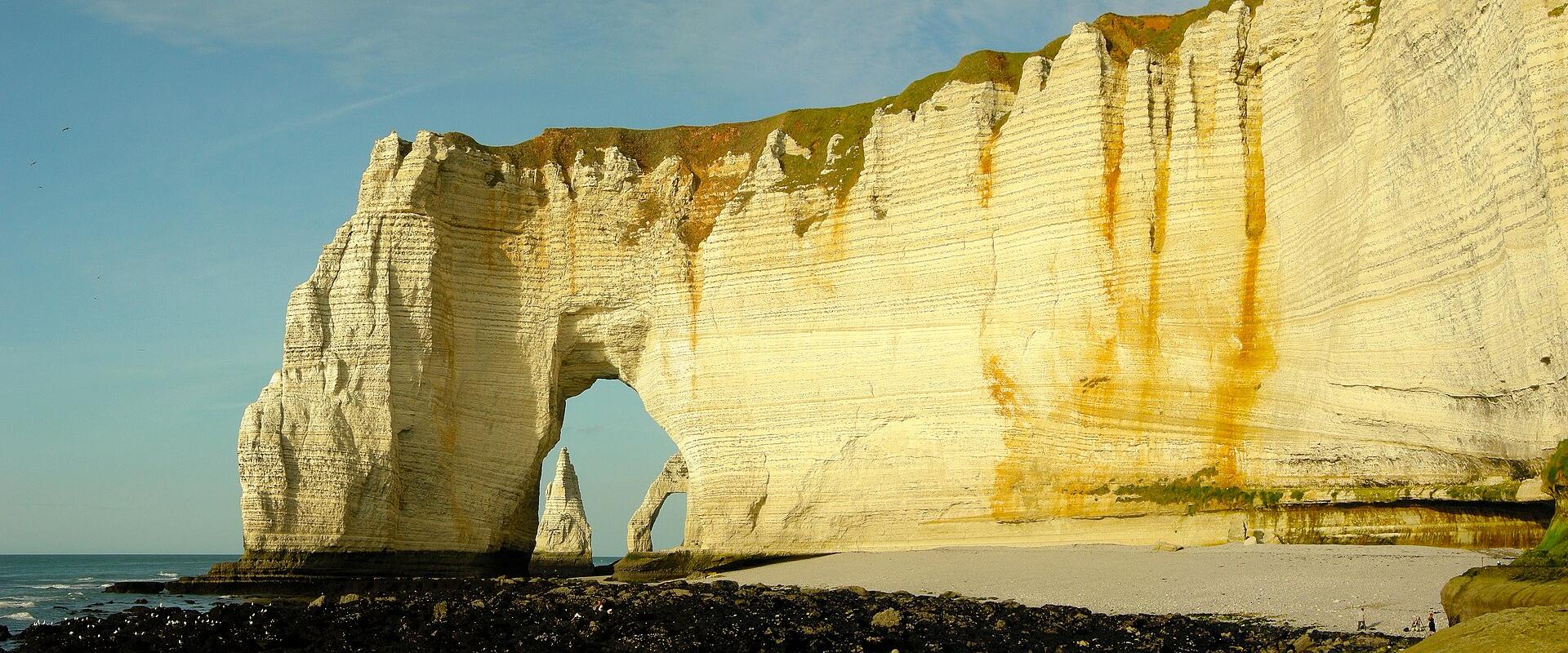
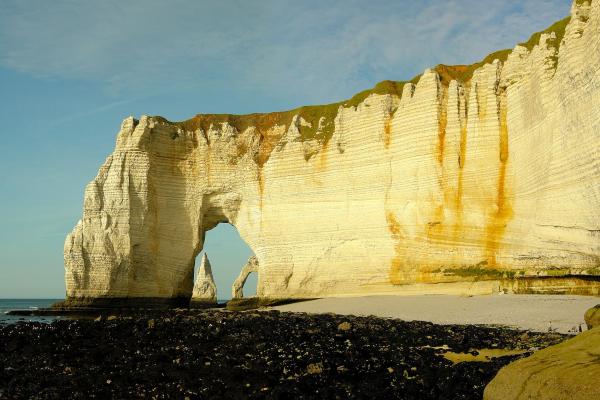
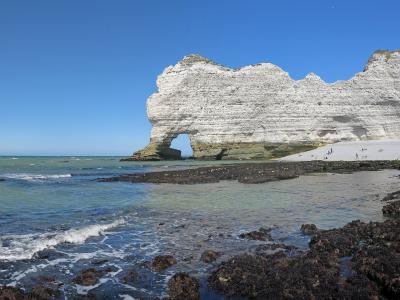
The Falaises d'Étretat are among the most recognisable coastal landscapes in France: tall chalk cliffs on the Normandy coast, with natural arches and a needle of rock standing in the sea. The town of Étretat sits in a small gap between two great headlands, with a pebble beach curving in front of it. To the west is the Falaise d'Aval, with the famous Porte d'Aval, an arch that looks like an elephant dipping its trunk in the water, and the Aiguille, a slender rock pillar rising from the surf. A little farther along lies the Manneporte, another and larger arch that is best seen from the sea or from the shingle at low tide. To the east, the Falaise d'Amont has its own arch, the Porte d'Amont.
The white rock is chalk, laid down in the sea more than ninety million years ago and now battered by waves, wind and rain. Flint nodules form dark bands in the white, and the sea gradually carves out arches and stacks, which eventually collapse. The process is continuing, and rockfalls are a real danger, so keep away from the edges and from the foot of the cliffs, and check the tides, since the water can cover the beach at the base within a short time.
The cliffs have also long attracted artists and writers. Claude Monet painted them many times in different weather and light, Gustave Courbet showed the waves breaking beneath them, and the novelist Maurice Leblanc used the Aiguille as the setting for the hollow needle in his Arsène Lupin stories. A monument on the Falaise d'Amont recalls the aviators Nungesser and Coli, who took off in 1927 to try to cross the Atlantic and vanished, and a small chapel, Notre-Dame de la Garde, stands nearby, where sailors' families prayed. The Jardins d'Étretat, a separate, ticketed attraction, lies on the same side of the town and has its own opening hours.
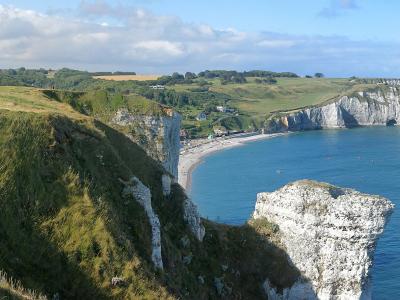
The best way to see the cliffs is on foot. Paths climb from both ends of the beach, and the cliff-top route along the coast is part of the long-distance footpath network. From the top you look down on the arches and across the Channel, and in good weather the views stretch far along the coast. Bring windproof clothing and sturdy shoes, since the grass can be slippery. The Plage de l'Amont and the Cap de la Hève, farther down the coast, are other ways to see the same chalk.
Plan on several hours for a walk with photographs. It suits walkers, families and photographers, and sunrise or late afternoon often gives the best light.
Categories
More photos coming soon
Hours & Fees
- Open
- Open year-round, 24/7
- Admission
- Free entry
Hours and prices change, especially out of season. Check with the venue before you go.
Nearby Attractions
Other places to visit in Etretat
Questions people ask
Quick Facts
Best Time to Visit
Late June to mid-September offers warm weather and ideal conditions for outdoor activities and sightseeing.