Lyon's Fête des Lumières, the Festival of Lights, runs over four evenings in 2026: Saturday 5 to Tuesday 8 December. The installations are lit from 19:00 to 23:00 on Saturday, Monday and Tuesday, and from 18:00 to 22:00 on Sunday. Everything is free and outdoors, spread across a pedestrian zone in the city centre, with around thirty light installations over the four nights and some three to four million visitors. It is one of the biggest events in France, and it suits anyone who can handle crowds: couples, photographers, students, and families willing to plan their evening.
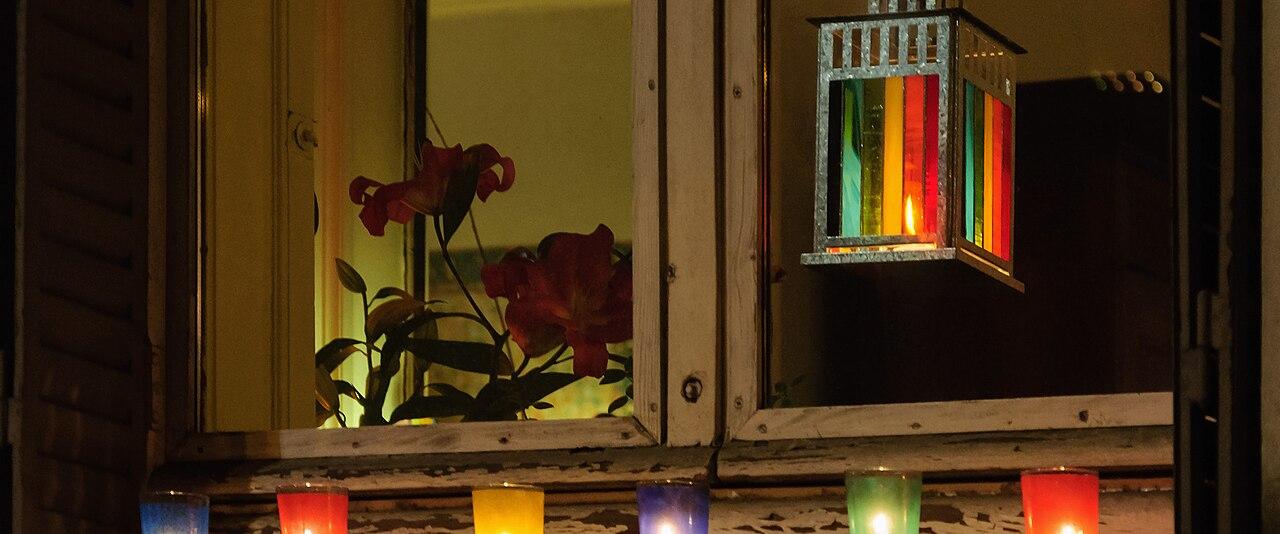
At its heart is a much older and quieter tradition. On the evening of 8 December, people in Lyon put small candles in coloured glass holders, the lumignons, on their windowsills. Those candles, not the projections, are what the festival is really about, and seeing them flicker along the façades of the old town is the part most visitors remember.
Where It Comes From: 1643 and 1852
Lyon's devotion to the Virgin Mary goes back to the plague of 1643, when, on 8 September, the city councillors vowed to honour her if Lyon was spared. A procession still climbs to Fourvière hill every 8 December to light candles and make an offering.
The candles in the windows date from 1852. A gilded statue of the Virgin by the sculptor Joseph-Hugues Fabisch was to be inaugurated on the bell tower of the chapel on Fourvière hill. The ceremony was moved to 8 December, the feast of the Immaculate Conception, after the Saône flooded, and bad weather on the day threw the plans into confusion again. The people of Lyon lit up their windows anyway, and they have done so every year since. The city turned the custom into a modern festival of light art at the end of the 20th century; 1999 is usually given as the first edition in today's form.
 Joseph-Hugues Fabisch's gilded statue of the Virgin on the bell tower of the chapel on Fourvière hill, unveiled in 1852. Image: Joseph-Hugues Fabisch, Public domain, via Wikimedia Commons.
 A medal struck for the inauguration of the statue of Notre-Dame de Fourvière, dated 8 December 1852. Image: Romainbehar, CC0, via Wikimedia Commons.
The Lumignons, and How to Join In
You can take part rather than just watch. Lumignon candles are sold in Lyon ahead of the festival (the festival website lists where), and the proceeds go to the Lumignons du Cœur, the festival's charity scheme. In 2026 the beneficiary chosen by the City of Lyon is Vivre aux Éclats, an association of hospital clowns that has worked in hospitals and care homes around Lyon for 30 years. The target is €50,000, enough for 1,700 visits by a pair of clowns: in the festival's own arithmetic, one lumignon sold is one smile, and fifteen pay for one visit. The candles also go into a collective light installation on Place Bellecour, built with the public.
 Lumignons, small candles in coloured glass holders, on a windowsill in Lyon on 8 December. Image: Myrabella, CC BY-SA 4.0, via Wikimedia Commons.
Churches take part too: Saint-Nizier, on the Presqu'île, has lined its altar with candles during the festival, and a church is a calm, warm place to step into away from the crowds.
 Candles around the altar of the Église Saint-Nizier during the Festival of Lights. Image: Romainbehar, CC0, via Wikimedia Commons.
Practical info: buy lumignons in the city before 8 December and light them on your hotel or apartment windowsill on the evening of the 8th, as residents do; if you are not staying in the centre, look for the Place Bellecour installation and the churches of the Presqu'île and Vieux Lyon.
Where the Installations Are
The 2026 programme and route map were not out when this guide was written: the festival publishes a digital version on its website in early November and a printed version at its information points from late November. Expect the installations to be spread across the historic centre and beyond: the festival describes them as running from the city centre right out to the suburbs.
In 2025, works were set up at the Gare Saint-Paul, along the quays of the Saône, at the Cathédrale Saint-Jean, on Place Louis Pradel, Place d'Albon and Place des Terreaux. Several monuments, including the Saint-Jean Cathedral, the Palais de Justice, the Basilica of Fourvière and the Théâtre des Célestins, have their usual lighting switched off during the festival, so the city looks quite different from a normal winter night.
 The Temple du Change in Vieux Lyon, lit at night. Image: Gonedelyon, CC BY-SA 3.0, via Wikimedia Commons.
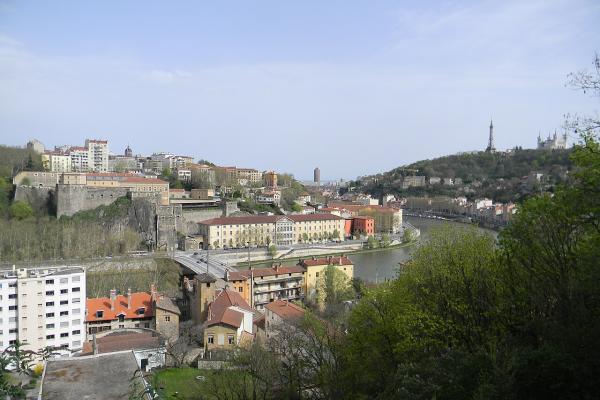
The Basilica of Notre-Dame de Fourvière, on the hill above Vieux Lyon, is the backdrop to the whole festival, and the view of the city from its esplanade is worth the climb even in a normal week; the funicular from Vieux Lyon is the easy way up.
 The Basilica of Notre-Dame de Fourvière and the metal tower on Fourvière hill, seen at night from the city below. Image: This picture belongs to Xavier Caré. Please credit : Xavier Caré / Wikimedia Com, CC BY-SA 4.0, via Wikimedia Commons.
Practical info: Pedestrian zone in central Lyon, with about forty entry points, roughly one every 100 metres. 5–8 December 2026: Saturday, Monday and Tuesday 19:00–23:00; Sunday 18:00–22:00. Free. Programme and map: fetedeslumieres.lyon.fr from early November.
Rules Inside the Festival Zone
- No vehicles. Cars, motorbikes, scooters, bicycles and e-scooters are not allowed inside the zone.
- No takeaway alcohol, no café terraces and no glass. All three are banned throughout the perimeter during the festival; bring a reusable or recyclable bottle.
- Expect queues at the entry points and allow extra time on Saturday and on 8 December, the busiest evenings.
- Accessibility: visitors with a French Mobility Inclusion Card (CMI) get skip-the-line access, a dedicated entrance and parking for people with reduced mobility; the festival's "Handi-accueil" page has the details.
Getting There and Getting Around
Lyon has two main railway stations, Part-Dieu and Perrache, with TGV services from Paris and the rest of France, and Lyon–Saint-Exupéry airport is linked to Part-Dieu by tram. Once you are in the centre, walk: the installations are inside a pedestrian zone, and on the main evenings the metro stations around it are packed. The TCL public transport network usually adapts its service for the festival, with some stations affected by the crowds, so check the TCL website for the 2026 arrangements before you rely on a particular stop.
 Crowds in a Lyon metro station on the evening of 8 December 2006. Image: TwoWings, Public domain, via Wikimedia Commons.
Do not plan to drive into the centre. If you arrive by car, leave it outside the city and come in by public transport.
Lyon's Christmas Market on Place Carnot
The festival is not Lyon's only December attraction. The city's Christmas market sets up on Place Carnot, in front of Perrache station, from 20 November to 24 December 2026, according to the City of Lyon. It is open 11:00–20:00 Monday to Thursday, 11:00–22:00 on Friday, 10:30–22:00 on Saturday and 10:30–20:00 on Sunday, and entry is free. During the Festival of Lights, from 5 to 8 December, its closing times are set by the city or the prefecture, so they may change at short notice. Come in the afternoon before the installations light up, and walk north through the Presqu'île as darkness falls.
Practical info: Place Carnot, Lyon 2e, next to Perrache station (metro line A). 20 November to 24 December 2026. Free.
What to Eat and Drink in December
Lyon calls itself the capital of French gastronomy, and the festival is a good excuse to eat the local way. In a bouchon, the city's traditional small restaurant, look for quenelles (light dumplings, often with a crayfish sauce), saucisson brioché (sausage baked in brioche) and salade lyonnaise. At Christmas, Lyon has its own sweet tradition, the papillotes: chocolates wrapped in shiny paper with a printed message or riddle inside, widely sold in the city's chocolate shops in December. On the street, expect vin chaud and roasted chestnuts at the market stalls, but remember that takeaway alcohol is banned inside the festival zone during the four evenings.
A Two-Evening Plan
First evening: arrive in the afternoon, see the Christmas market on Place Carnot, then walk up the Presqu'île to Place Bellecour for the lumignons installation and on to Place des Terreaux. Have a late dinner in a bouchon you booked in advance.
Second evening (ideally 8 December): spend the afternoon in Vieux Lyon and take the funicular up to Fourvière for the view before dark. Come down as the candles appear in the windows of the old town, then follow the installations along the Saône quays and the Cathédrale Saint-Jean.
Where to Stay
Book as early as you can; the Lyon Tourist Office handles bookings for hotels and restaurants on visiterlyon.com and recommends reserving well in advance.
- Presqu'île (Bellecour, Cordeliers, Terreaux): in the middle of the festival zone; you can walk out of the door into it, but rooms are scarce and most expensive.
- Vieux Lyon: cobbled Renaissance streets under Fourvière, atmospheric on 8 December when the windows are full of candles; few hotels, so book early.
- Croix-Rousse: the hill north of the Presqu'île, a walk down the slopes to Terreaux, quieter at night.
- Part-Dieu: business hotels next to the main station, a metro ride from the centre, and the most practical if you arrive by train.
- Confluence and Perrache: south of the Presqu'île, convenient for Perrache station.
Tips for the Evening
- Choose your night. Sunday has the earliest hours (18:00–22:00) and suits families; Saturday and Tuesday 8 December, the traditional night, are the busiest.
- Go early or late. Arrive when the lights come on, or after 21:30 when the first crowds thin out.
- Pick a route rather than chasing everything. With thirty installations spread over a large area, choose one district per evening: the Presqu'île one night, Vieux Lyon and the Saône quays the next.
- Agree a meeting point. Mobile networks can be overloaded in the densest crowds, so decide in advance where to meet if your group gets separated.
- Book dinner. Restaurants in the centre are full on festival nights; reserve a bouchon, Lyon's traditional restaurant, or eat earlier than usual.
- Dress for standing still. Early December evenings in Lyon are cold, and you will spend hours outside watching installations rather than walking.
- Light your own lumignon. Even if you only stay for one night, make it the 8th, and put a candle in your window.