How to Approach the Route
Burgundy's castles are spread over a wide area, from the wine slopes south of Dijon to the wooded valleys of the Yonne near Auxerre. Unlike the Loire, where châteaux cluster along one river, the Burgundy sites are best visited on a loop by car over three or four days. Dijon makes a natural starting point, with fast trains from Paris and car hire at the station. The route below runs south through the vineyards, west into the Auxois hills, then north-west into the Yonne, with an optional detour to a castle still under construction.
Many of these châteaux are privately owned and open on a seasonal timetable, typically from spring to autumn, with reduced hours or closures in winter. Check each one's website before setting out, and expect guided-tour-only visits at some.
Day One: Clos de Vougeot and the Côte de Nuits
From Dijon, follow the Route des Grands Crus south through Gevrey-Chambertin and Chambolle-Musigny to the Château du Clos de Vougeot. This is less a fortress than a working monastic wine estate: Cistercian monks from the nearby abbey of Cîteaux planted and walled the vineyard in the Middle Ages, and the buildings include a huge medieval cuvier with enormous wooden wine presses and a Renaissance main house. Since the 1940s it has belonged to the Confrérie des Chevaliers du Tastevin, a Burgundy wine brotherhood that holds its banquets there.
The surrounding villages have wine-tasting rooms, and the vineyards are part of the Climats of Burgundy UNESCO World Heritage listing. If you plan to taste, designate a driver or spit, as French drink-driving limits are strict.
Day Two: Commarin and Châteauneuf-en-Auxois
Head west towards Pouilly-en-Auxois. The Château de Commarin, surrounded by water-filled moats, has been passed down through the same extended family for centuries, and its rooms keep furniture and heraldic tapestries collected over that time.
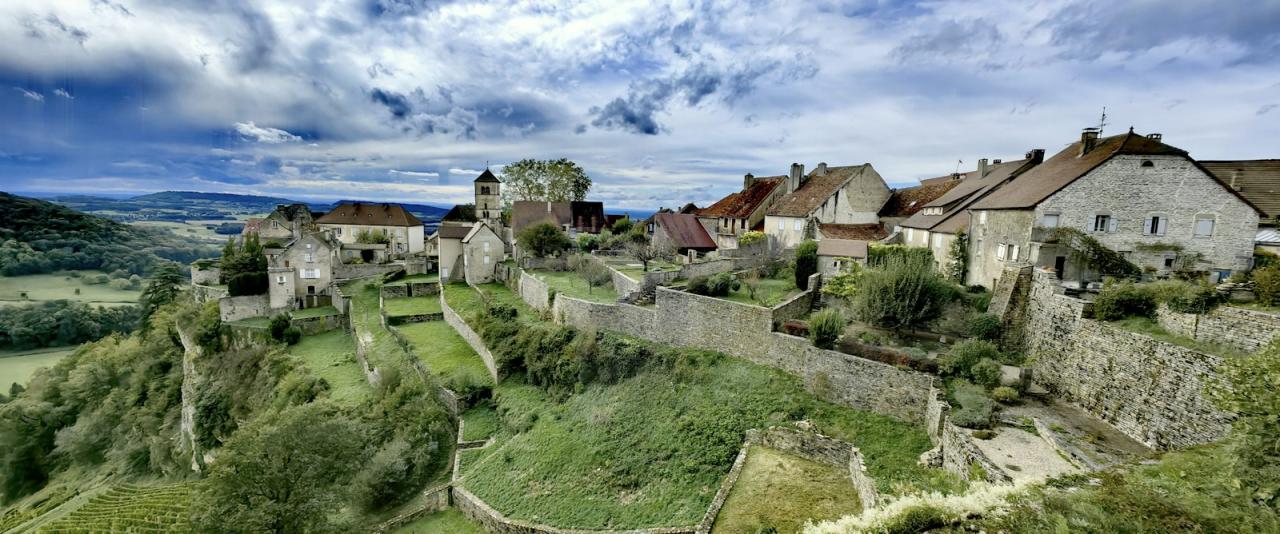
A short drive away, Châteauneuf-en-Auxois sits on a ridge above the Burgundy Canal and the A6 motorway. Its medieval castle, with towers and a fortified gatehouse, was built from the 12th century onward and guarded the route between Dijon and Autun. The village around it is listed among the Plus Beaux Villages de France, and the views over the canal valley are the reason to come. Walk the lanes before or after visiting the castle.
Day Three: Bussy-Rabutin and the Auxois
Continue north-west to the Château de Bussy-Rabutin near Montbard, managed by the Centre des monuments nationaux. In the 17th century Roger de Bussy-Rabutin, a soldier and writer exiled from the court of Louis XIV for a satirical book, spent years decorating its rooms with painted portraits of royal mistresses, generals and famous figures, often with sharp captions. The result is one of the more personal interiors in France. Formal gardens surround the house.
Nearby are the Abbaye de Fontenay, a Cistercian abbey on the UNESCO list, and Alise-Sainte-Reine, the probable site of the siege of Alesia, now home to the MuséoParc Alésia. Either can fill an afternoon.
Day Four: Ancy-le-Franc and Tanlay
Ancy-le-Franc, on the Burgundy Canal in the Yonne, is a Renaissance château built in the 16th century to designs associated with the Italian architect Sebastiano Serlio. Its plain exterior hides painted galleries and rooms decorated by artists from the Fontainebleau school.
A short drive further on, the Château de Tanlay sits behind wide moats and combines Renaissance and early classical architecture, with painted trompe-l'oeil ceilings inside. The two make a good pairing for a single day.
Optional Detour: Guédelon
If you have an extra day, drive west into the Puisaye to Guédelon, near Treigny. Since 1997, masons, carpenters and other craftspeople have been building a 13th-century-style castle from scratch using only medieval techniques and local materials. It is a construction site rather than a finished monument, open seasonally, and is especially good for families.
Practical Notes
- Car: Essential. Public transport between these sites is thin, and some are several kilometres from the nearest station.
- Base towns: Dijon and Beaune for the Côte d'Or; Semur-en-Auxois for the middle section; Tonnerre or Auxerre for the Yonne.
- Timing: Late spring and early autumn are pleasant and less crowded; the harvest season in September brings activity to the wine villages.
- Southern alternative: From Beaune, the Château de La Rochepot with its glazed-tile roofs and the moated Château de Sully near Autun make a shorter, separate loop.