Ajaccio at a Glance
Ajaccio is the largest city in Corsica and the seat of the island's regional government. It sits on the north shore of a wide gulf on the west coast, with mountains behind it and a string of beaches to the west. The city was founded by the Genoese in the late 15th century, and its most famous son, Napoleon Bonaparte, was born here in 1769. It is a practical base for exploring southern Corsica, with an airport, ferry port and a compact old town.
Napoleon Sites
- Maison Bonaparte: the family home in the old town, where Napoleon was born, is now a national museum. Rooms are furnished in period style and display family portraits and documents. Allow about an hour. Opening days and hours change with the season, so check before you go.
- Cathédrale Notre-Dame-de-la-Miséricorde: the cathedral where Napoleon was baptised, a short walk from his birthplace.
- Place Foch and Place d'Austerlitz: two of several squares with monuments to the emperor. Place Foch has a statue of Napoleon as First Consul surrounded by lions. The large monument on Place d'Austerlitz, west of the centre, shows him in his familiar long coat and hat.
Palais Fesch and the Old Town
The Palais Fesch – Musée des Beaux-Arts was founded by Cardinal Joseph Fesch, Napoleon's uncle, who assembled a large collection of paintings. Its Italian paintings, from the 14th to the 19th centuries, form one of the most important collections of their kind in France outside the Louvre. The adjoining Imperial Chapel holds tombs of members of the Bonaparte family.
The old town between the cathedral and the port is a grid of tall, narrow streets with shuttered houses. The citadel overlooks the sea at its edge. The morning market near Place Foch sells Corsican produce such as cheeses, charcuterie, honey and chestnut products, alongside fruit and vegetables.
The Route des Sanguinaires
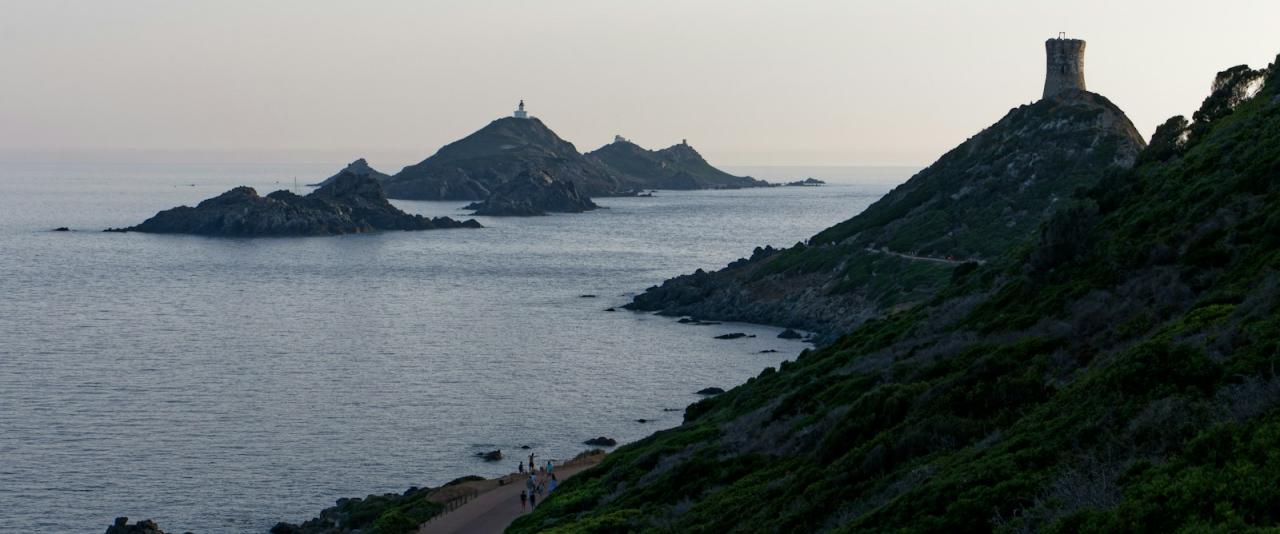
West of the city, the Route des Sanguinaires follows the north shore of the gulf for about 12 km to the Pointe de la Parata. Along the way are several sandy beaches, with easy access from the road, and the city's cemetery and chapels with sea views.
At the end, the Pointe de la Parata is a rocky headland topped by a Genoese watchtower. From the car park, a footpath climbs to the tower, and a longer coastal path circles the headland. Offshore lie the Îles Sanguinaires, a small archipelago of four dark red granite islands. The largest, Mezzu Mare, has a lighthouse. The site is particularly popular at sunset, when the islands turn red, and the car park fills up in summer evenings.
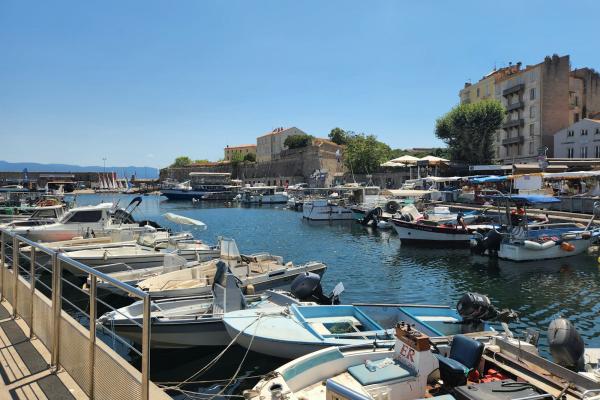
City buses run out along the route to the Parata in season, which saves searching for parking. Boat trips from Ajaccio's harbour sail around the islands and along the coast, with some stopping on Mezzu Mare. Bring water and sun protection, as there is little shade on the headland.
Beaches
The beaches along the Route des Sanguinaires are the closest to the city and are busy on summer weekends. Across the gulf, the southern shore around Porticcio has longer sandy beaches and is reached by road or, in season, by boat shuttle from Ajaccio. Water temperatures are warmest from July to September. Most of them have cafés or snack bars close by during the summer season.
Getting There and Around
Ajaccio Napoléon Bonaparte Airport is a few kilometres east of the city, with flights from mainland France and, in summer, from other European cities. Ferries connect Ajaccio with Marseille, Toulon and Nice. The Corsican railway, the Chemins de fer de la Corse, links Ajaccio with Corte and Bastia through the mountains, a slow but scenic journey. Trains are infrequent, so check the timetable before planning a day trip by rail.
The centre is easy to walk. To explore beyond the city, including the Calanques de Piana to the north or the southern coast, a rental car gives the most freedom, as bus services outside the main towns are limited.
When to Visit
Late spring and early autumn are the most comfortable seasons, with warm sea temperatures in September and fewer crowds than in July and August. On 15 August, Napoleon's birthday coincides with the Assumption holiday, and the city usually marks it with celebrations. In winter Ajaccio remains a working city, but many beach businesses close.